Chinese researchers develop nuclear-clock model about six times more stable
Models developed by researchers at Tsinghua University tested about six times more stable than a Vienna team's model, though the technology still needs improvements before practical applications.
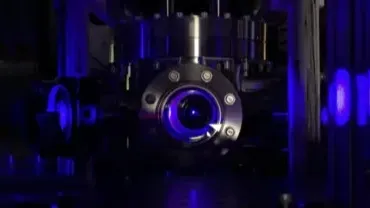
Chinese researchers have made progress in developing nuclear clocks after tests of an experimental model they developed showed stability about six times higher than a counterpart created by a scientific team in Vienna, which could pave the way to developing ultra-precise timekeeping tools and broader scientific applications.
The technique relies on the nuclei of thorium-229 atoms rather than the electrons used in conventional atomic clocks, in an attempt to reduce the impact of external disturbances and improve the stability and accuracy of measurements in the future.
The model developed by researchers at Tsinghua University is based on crystals that contain thorium-229 nuclei, which are illuminated with ultraviolet light using a laser. When the nuclei respond to light at a specific frequency, that nuclear transition can be used as a reference to set the clock's frequency and measure its stability.
This approach differs from conventional atomic clocks because it relies on energy transitions within the nucleus itself rather than transitions of surrounding electrons, and because the nucleus is small and its components are tightly bound, scientists hope it will provide a reference less affected by external factors that influence measurements.
Tests showed that the signals from two crystals produced independently agree to a high degree, which strengthens the possibility of repeating the experiment and obtaining similar results when manufacturing new crystals instead of relying on a single exceptional sample.
However, the results do not mean that the Chinese nuclear clock has become the most accurate clock in the world; advanced atomic and optical clocks still outperform it in overall performance. Developing the technology requires improving laser systems, raising crystal quality, and reducing defects within them to enhance stability and accuracy.
The scarcity of thorium-229 also poses an additional challenge because it limits the ability to conduct repeated experiments using crystals with different properties. The nuclear clock remains in the development stage and has not yet reached the level of widespread practical use.
The importance of nuclear clocks is not limited to timekeeping; they could enable tests of some fundamental laws of physics and searches for possible signatures of dark matter by detecting extremely small changes in physical constants. A scientific team in Vienna had used its nuclear clock in an experiment to search for dark matter, but it did not yield evidence of its existence.
In the long term, researchers hope to develop compact nuclear clocks used in satellite navigation, ultra-precise measurements, and data synchronization, provided the technology achieves higher levels of stability and accuracy that allow a transition from laboratory experiments to practical applications.



