Google disables Search and Gemini by default in student accounts until districts enable them
Google announced that Search and Gemini will be disabled by default in student accounts from kindergarten through the end of high school until school districts choose to enable them. The company is offering a “Guided Learning” option, plans a pilot in November, and will begin implementing changes in early 2027.
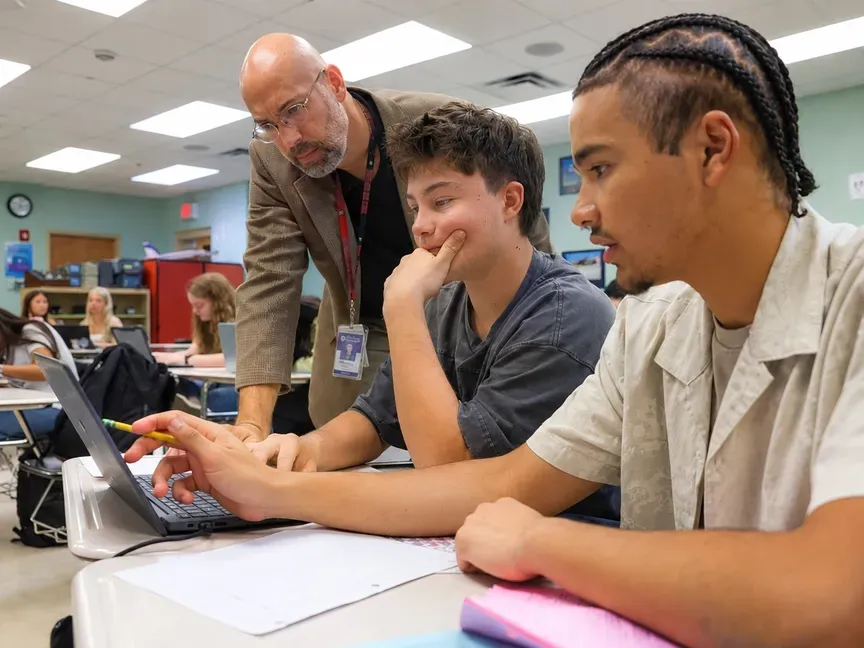
Google announced that Search and Gemini services will be disabled by default in school student accounts from kindergarten through the end of high school, until school administrations decide to enable these tools. The company said in a statement that the change came after listening to schools, teachers, researchers and policymakers before updating controls.
Google said the changes include Gemini, Gemini Notebook, Gemini in Classroom and Search in student accounts, noting the company’s policy allows Search and the Gemini assistant to be enabled separately. However, it added that schools that want to remove generative AI features from the Search interface will not find an official option to restore a traditional version free of those features.
Chris Phillips, Google’s vice president and general manager of Education, told reporters that Search and AI are closely linked, and any school that chooses to disable AI entirely may have to turn off the Search engine as well, according to media reports conveying details of the meeting.
The company said implementation of the changes will begin in early 2027, and that it will share implementation details with school districts in the coming months to allow sufficient time to prepare.
As a solution to concerns about reliance on ready-made answers, Google introduced a “Guided Learning” option intended to walk students through sequential questions and steps instead of providing the solution directly. The company plans to begin piloting Search capabilities in this format in selected U.S. schools in November, before expanding later, according to media reports.
Within Google Classroom, Google began rolling out the “Guided Learning” feature globally on November 3 to work on materials specified by the teacher, while providing information to help teachers track student engagement and identify areas needing support.
These moves come amid criticism over the expanding use of AI tools in U.S. schools, after Google in August announced expanded availability of Gemini inside Classroom for students of all ages — a step that drew reactions from some schools that were surprised by how quickly access widened and were forced to make swift decisions to either allow the tool or block it before completing evaluations and teacher training.
On October 21, Senators Richard Blumenthal and Josh Hawley sent a letter to Google and Alphabet CEO Sundar Pichai asking for answers about built-in AI features and the difficulty of disabling them, research on the tools’ impact on children’s mental health, and measures to limit emotional attachment to chatbot systems.
Locally, New York City took a stricter path in September by announcing a one-year halt to the use of generative AI directed at students from early education through eighth grade for the 2026–2027 school year, a decision affecting about 600,000 students, while keeping limited, vetted pilots in high schools and allowing teachers to use approved tools for planning and administrative tasks.
Google was also confronted with results of a test conducted by Common Sense Media in July, which showed that AI Mode in conversational Search provided complete answers to all 180 assignments included in the test.
In response to criticism, Google defended its “Guided Learning” approach with results from research it cited, including a randomized trial involving more than 300 students at the University of Tokyo on a statistics topic over several hours that showed higher scores among those who used “Guided Learning” compared with those who relied only on usual resources, as well as a four-week trial in three British high schools that received positive feedback from teachers and students.
Google said teacher feedback prompted it to develop the platform further, provide clearer information about student interaction with course materials, and improve linking of conversations to content uploaded by teachers.