New scientific explanation for the “Great Gap” and the missing billion years of Earth’s geological record
Researchers suggest that hot currents deep in the crust caused ancient continents to rise and fall, wiping out about a billion years from the geological record known as the “Great Gap.”
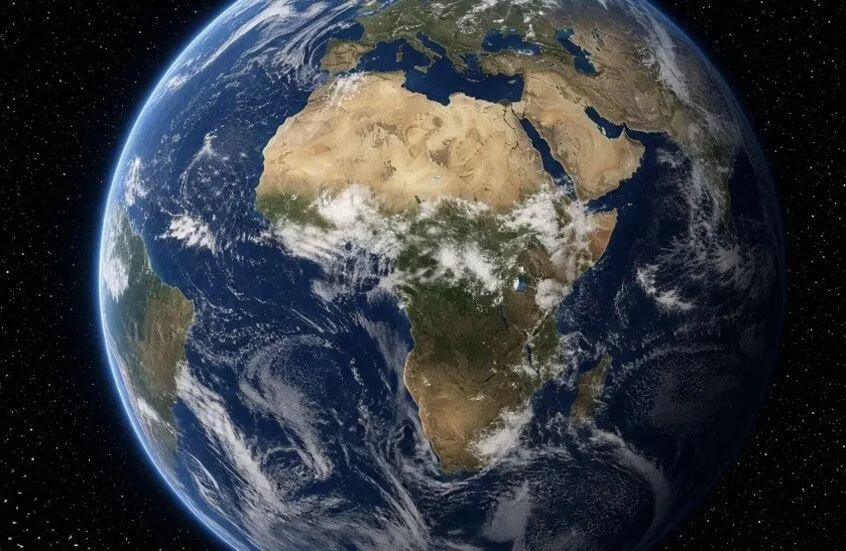
Researchers have revealed a possible explanation for the geological mystery known as the “Great Gap,” which consists of the disappearance of about a billion years from Earth’s historical record — a term coined by the American explorer John Wesley Powell in the nineteenth century.
A recent study by a research team at Australia’s University of Wollongong suggests that this wide and unexplained time gap between sedimentary rocks and older crystalline rocks may be due to the activity of hot currents deep in the Earth’s crust, which caused uplift and subsidence of ancient continents. Modeling showed these currents uplifted vast areas of land hundreds of millions of years ago, before later causing them to sink and be submerged under layers of sediment in the oceans.
In this context, Associate Professor Nicola Flaman said the missing portions of the geological record may tell us more about Earth’s history than the rocks that remain, noting that long periods of uplift followed by subsidence would create conditions ideal for removing rock and preserving the eroded surface.
Evidence of this gap is spread across several geographic regions, including New Mexico and the Grand Canyon in Arizona, which were part of the ancient continent known as Laurentia, with similar indications appearing in Europe, Australia, Africa and Asia. The researchers say the most well-documented evidence is concentrated in North America, northern Europe and northern China, where modeling suggests deep currents uplifted continents during the Neoproterozoic (between one billion and 541 million years ago) — the era that ended with the start of the Cambrian and saw an explosion in animal life diversity.
Earlier hypotheses had attributed this erosion to glacial activity during the “Snowball Earth” interval (between 635 and 720 million years ago), but a study by researchers at the University of California, Santa Barbara argued that granite erosion in Colorado occurred before that interval, specifically between one billion and 720 million years ago, and linked it to the assembly and breakup of the supercontinent Rodinia, which included Laurentia.
Geologist Francis MacDonald said the core hypothesis is that this widespread erosion was a direct result of the formation and breakup of supercontinents. Nevertheless, proving these theories remains a major challenge because the primary evidence depends on rocks that are already missing, forcing researchers to rely on existing data to fill those time gaps.