Shadow government in Iraq: political oversight or a project to reform government performance?
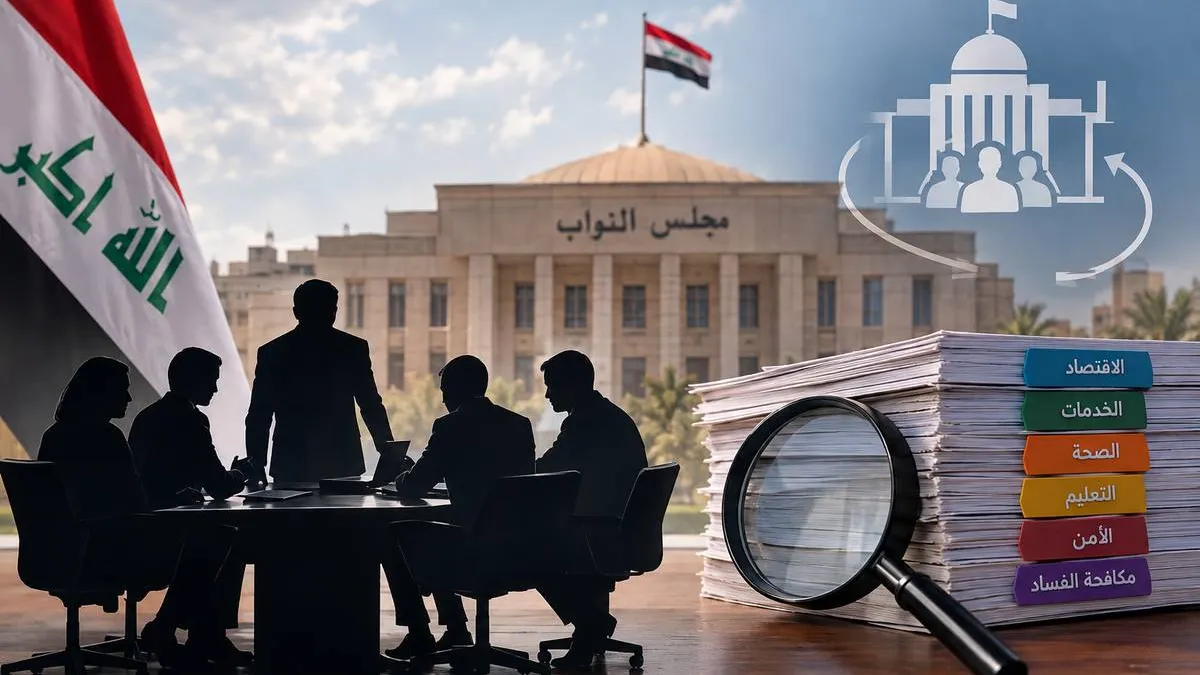
Shadow government in Iraq: political oversight or a project to reform government performance?
Al-Wasat newspaper – Political dossier
Against the backdrop of the political, economic and administrative challenges facing Iraq, the concept of a “shadow government” emerges as one of the political models that could help strengthen oversight of the executive branch, offer practical alternatives to government policies, and raise the level of public debate about state management. But applying this concept in Iraq raises important questions about the nature of the political system, the role of the opposition, and the ability to move from traditional political competition to competition based on programs and results.
What is meant by a shadow government?
A shadow government is a political team usually formed from opposition representatives that works to monitor the performance of the sitting government across various sectors—such as the economy, security, education, health, energy and services—while preparing alternative policies and proposals that could be implemented if the forces it represents come to power.
This model differs from the official government; members of a shadow government do not possess direct executive authority and do not run ministries or government institutions. Their primary task is to follow government decisions, analyze their outcomes, expose shortcomings, and present alternative solutions to the public and parliament.
This model is especially known in parliamentary systems where the opposition has a clear and organized role: shadow team members follow the files of the ministries corresponding to their work and provide evaluations and political positions on government decisions.
Does Iraq need a shadow government?
Iraq has a parliamentary political system, and the government, parliament and oversight bodies perform different roles in managing the state and monitoring its institutions. Nevertheless, the presence of an organized opposition with a clear program and an alternative vision could add another level of political monitoring, provided it is not merely an extension of existing partisan conflicts.
Iraq faces complex files, including heavy reliance on oil revenues, challenges of economic diversification, providing job opportunities, improving public services, addressing administrative and financial problems, and developing the electricity, health and education sectors.
In such circumstances, an organized shadow government could provide periodic assessments of ministry performance, clarify to the public which government promises have been fulfilled and which have not and the reasons for any delays, and propose feasible alternatives instead of limiting itself to political criticism.
How could an Iraqi shadow government operate?
One can envision forming a specialized team that includes political figures and economic, legal and administrative experts, with each member responsible for a specific portfolio and publishing periodic reports based on official data and information lawfully available.
First: the economic and financial portfolio
The team responsible for the economy would study the general budget, government spending, non-oil revenues, tax policy, investment opportunities, levels of debt and financial obligations. It could also propose measures to reduce waste, improve spending efficiency and create sustainable jobs.
Second: services and energy portfolio
This team would monitor government plans related to electricity, water, roads, transport, health and education, comparing declared objectives with achieved results, identifying points of failure and suggesting practical remedies.
Third: anti-corruption and transparency portfolio
The team could follow up on reports from oversight bodies, analyze published government contracts and projects, raise questions about spending efficiency and conflicts of interest, and refer suspicions that warrant investigation to the competent authorities, while respecting the presumption of innocence and legal procedures.
Fourth: security and foreign affairs portfolio
Specialists would study security and diplomatic policies, follow regional and international developments, assess their impact on Iraqi interests, and propose alternatives based on protecting national sovereignty, stability and economic interests.
Fifth: legislation and parliamentary oversight
The team could prepare legislative proposals, analyze draft laws, follow up on parliamentary questions and interpellations, and offer observations on the extent to which government decisions align with the constitution and applicable laws.
Shadow government and combating corruption
One of the most prominent potential roles of this model is to enhance transparency in public finance management, since it could place government institutions’ performance under more regular political and media scrutiny.
But its success does not come from merely publishing accusations or exchanging statements; it requires reliable documents and information, measurable performance indicators, and a clear separation between political criticism and defamation of individuals.
This team should not replace the Federal Board of Supreme Audit, the Integrity Commission or the judiciary; these bodies have legal jurisdictions that differ from the political and oversight role a shadow government might perform.
What is the difference between a shadow government and the traditional opposition?
The traditional opposition often focuses on rejecting government policies or criticizing its decisions, whereas a shadow government is expected to go beyond that by offering detailed alternatives.
When it objects to an economic policy, it should explain the reasons for the objection, present an alternative vision, and clarify its cost, funding sources and expected outcomes.
When it criticizes the failure of a service project, it should rely on data about completion rates, cost and timelines, and specify the measures it proposes to address the problem.
In this sense, political competition shifts from a mere struggle for positions and influence to competition over program quality and managerial capacity.
Main challenges to implementing a shadow government in Iraq
Despite the potential benefits, applying this model faces a number of challenges.
The first is the nature of political competition: a shadow government could become a platform for partisan skirmishes if it is not based on a clear program and professional standards.
The second is the availability of information, because effective oversight requires accurate, up-to-date data on government spending, projects and actual results, with guaranteed lawful access to information.
The third challenge is independence: a team entirely subject to the interests of its party leadership may find it difficult to criticize mistakes or provide an objective assessment.
There is also the challenge of funding and expertise: forming a specialized team requires human resources, research institutions and mechanisms to review information before publication.
It is also necessary to avoid duplication of roles with parliament and official oversight bodies, and to define the relationship between political and oversight work on one hand and constitutional and legal jurisdictions on the other.
Does a shadow government need a special law?
That depends on its form and the nature of its activities. If it is a political or parliamentary team that practices opposition and issues reports and proposals, it may be possible to organize its work within existing legal and political frameworks, depending on its institutional status.
But if the proposal is to establish an official entity with general powers or a right to obtain documents not available to the public, or to exercise executive oversight powers, the matter would require a careful constitutional and legal study; one should not assume it has governmental or investigative powers without legal basis.
Therefore, the most realistic start may be to form a voluntary, organized shadow team composed of MPs, experts and specialists that issues public reports according to a clear methodology while making use of available parliamentary and legal tools.
How can its success be measured?
Success can be evaluated using practical indicators, such as the number of reports published and their quality, the extent to which they rely on reliable sources, the number of proposals that turn into legislative initiatives or parliamentary debates, the degree to which institutions respond to the observations, and the team’s ability to correct false information when it appears.
It is also important to measure the quality of the alternatives offered, not the number of statements made. A report that identifies a budget problem and proposes a feasible solution is more valuable than dozens of statements that do not offer a clear path for reform.
Conclusion
A shadow government is not a parallel government with executive powers, nor is it a substitute for parliament, the judiciary or oversight institutions. Rather, it is a political model that can enhance accountability and present different options to citizens.
In Iraq, this model could represent an opportunity to develop the opposition’s work and move from general criticism to evidence- and program-based oversight. However, its success will depend on independence, transparency and competence, and on the ability of those who run it to offer realistic solutions that go beyond narrow partisan interests.
Iraq does not need more political slogans as much as it needs institutions that monitor performance, reveal flaws with evidence, propose reforms, and place the interests of citizens and public funds at the forefront of priorities.