From AI to Robots and Space Computing: Where Has Technology Reached in 2026?
From AI to Robots and Space Computing: Where Has Technology Reached in 2026?
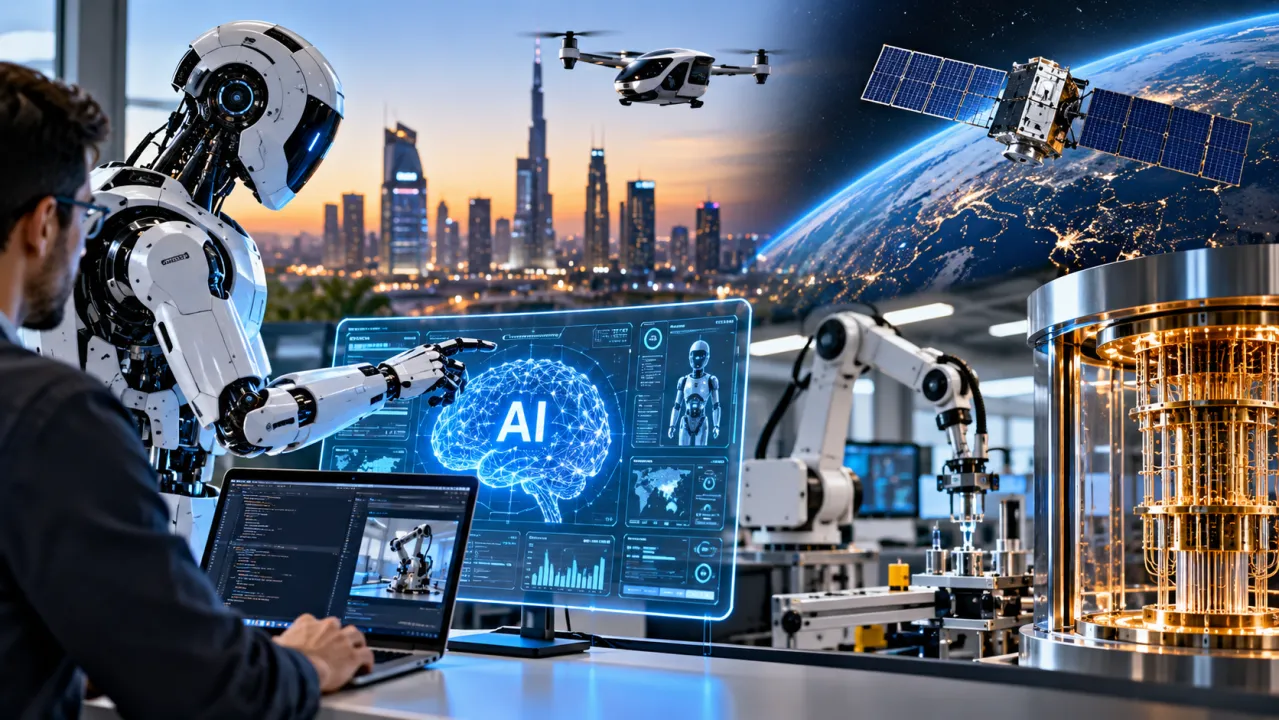
The year 2026 has not only been about faster phones and computers; it has become a turning point in which technology moved from programs that answer questions to systems that can carry out tasks, control robots, and understand the physical world, while major companies have even begun testing the possibility of moving part of AI infrastructure to space.
Artificial intelligence is no longer just "chat".
One of the biggest shifts during 2026 was the evolution of AI from systems that generate text and images to digital agents capable of executing a whole sequence of taskssuch as searching, analyzing data, writing software, and handling files and various tools.
And in September 2026 OpenAI unveiled the GPT-6 Astra generation, then released the GPT-6 Sol and Luna models in some of its products and APIs, with a greater focus on computing use, programming, research, and multi-step work.
This development indicates that the new phase of AI will not rely solely on a person asking the system a question and waiting for an answer, but on giving it a goal so it uses multiple tools until it reaches the result.
The robot learns by watching.
The most exciting development may be in what is known asphysical AI (Physical AI), meaning giving AI a body that can move and interact with real objects.
And Google DeepMind in 2026 revealed Gemini Robotics 2, which aims to give robots improved whole-body control, the ability to handle fine objects, and to adapt to changing environments.
In another development, Skild AI announced a robotic model that can learn some new tasks from a single demonstration video without needing to be retrained for each task separately, a direction that could in future reduce the need to program robots step by step.
NVIDIA has also pushed strongly into this field, through simulation platforms, robotics, and safety systems designed for machines operating near humans in factories, warehouses, and worksites.
AI centers in space?
One of the stranger projects in 2026 is the Suncatcher project from Google, which is exploring the possibility of running AI computing infrastructure in space.
The company is preparing to test a prototype satellite to determine the ability of AI chips to withstand radiation, vibrations, and cooling issues in vacuum, an exploratory step to see whether in the future it might be possible to run massive computing capabilities off Earth.
The project does not mean data centers will move to space soon, but it reveals the scale of research underway to find solutions for the power, cooling, and massive scaling that AI requires.
Quantum computing takes another step forward.
As for quantum computing, which for years remained tied to laboratories, in 2026 it became closer to testing real-world applications.
IBM's roadmap says it is working during 2026 to demonstrate early examples of what is called "quantum advantage" by integrating quantum computers with conventional supercomputers, alongside developing systems for real-time error correction. The company also stresses that these goals remain part of a research roadmap and may change.
Google also expanded its quantum research during the year to include computing using neutral atoms in addition to superconducting technologies.
The chip war enters a new phase.
All these technologies require enormous computing power, which is why semiconductor chips have become one of the main axes of global technological competition.
And in September Alibaba unveiled the Zhenwu V900 AI chip and said it delivers performance much higher than the previous generation, at a time when Chinese companies are expanding the construction of local models and data centers.
In the United States, AMD on September 28 announced an agreement worth US$8.2 billion to acquire World Labs, in a move that further links the chip industry with "spatial intelligence" that allows systems to understand three-dimensional environments.
What does that mean for the average user?
The technology landscape in 2026 shows that the next phase may not just be a faster phone or a new app, but devices and software that can see, understand, take actions, and interact with the real world.
Robots may become more present in factories and services, while AI systems take on larger portions of office, software, and research work. Conversely, safety, privacy, energy consumption, and the impact of automation on the labor market will remain among the main challenges accompanying this acceleration.
In short, the most notable change in 2026 is that artificial intelligence has begun to leave the screen and enter the real world., a trend described by recent tech reports as one of the year's most important technological shifts.