BYD Cars in Iraq: A Comprehensive Guide to Electric and Hybrid Models, Pros and Cons
BYD cars in Iraq: a comprehensive guide to electric and plug-in hybrid models, their advantages and disadvantages
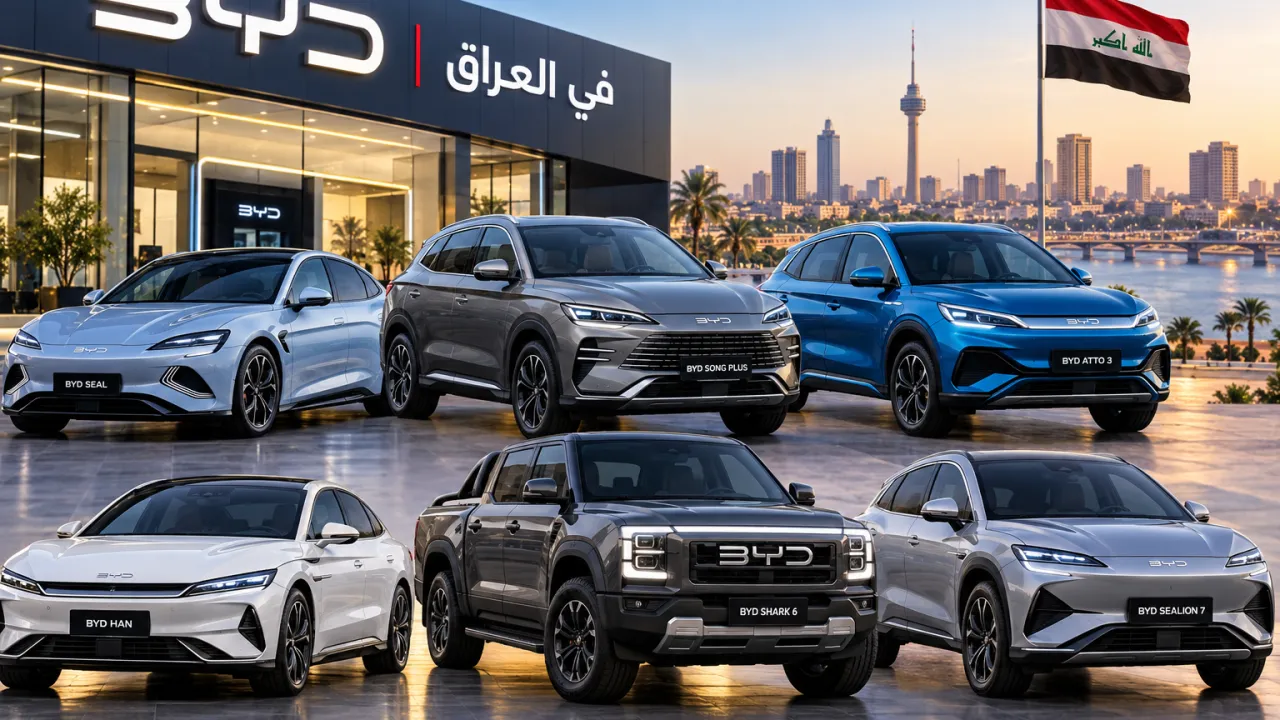
BYD Cars in Iraq: A comprehensive guide to the electric and hybrid models, advantages and disadvantages
Cars have become BYD in recent years one of the prominent names in the world of electric and hybrid vehicles. With the company's official entry into the Iraqi market, interest in it has increased, especially given the availability of multiple models that combine modern technologies, electric driving, and rechargeable hybrid systems.
But what are BYD cars? What is the difference between their electric and hybrid vehicles? How does the famous Blade Battery work? And are these cars suitable for daily use in Iraq?
In this guide we review the most important information someone needs before considering buying a BYD car.
What is BYD?
The name BYD is associated with the phrase Build Your Dreams; it is a Chinese company that began operations in 1995 in the field of rechargeable batteries before later expanding into car manufacturing, energy, and electronics.
This background in batteries is an important part of the company's identity, because BYD does not rely solely on buying batteries from other companies; it has developed its own battery technologies and electric systems.
Today the company produces fully electric cars, as well as plug-in hybrid vehicles, in addition to luxury sub-brands such as DENZA and YANGWANG.
What are BYD cars?
Modern BYD cars can be simply divided into two main categories:
Fully electric vehicles (EV)
are vehicles that do not contain a conventional gasoline engine to propel the car, but rather rely on a large battery and an electric motor.
The battery is charged from an external electrical source, after which the car uses the stored energy to move.
Advantages of electric cars include a very quiet motor, quick throttle response, and fewer maintenance parts compared with conventional gasoline engines.
However, the range a car can cover depends on battery capacity, driving style, temperature, air-conditioning use, vehicle speed, and road conditions.
BYD plug-in hybrid cars
The second category is plug-in hybrid vehicles (Plug-in Hybrid or PHEV).
These cars contain:
- an electric motor.
- a rechargeable battery.
- a gasoline engine.
- an electronic system that manages the operation of both systems.
Thus the driver can operate the car electrically for a certain distance when charged, while the gasoline engine provides greater flexibility for long-distance travel.
BYD uses in several of its cars a hybrid system known as DM-i Super Hybrid.
What is the DM-i system in BYD cars?
The DM-i philosophy differs from some traditional hybrid systems because BYD designed it to be primarily dependent on electric driving, while the gasoline engine plays a supporting role depending on driving conditions and battery charge.
When there is sufficient charge, the car can operate electrically in many conditions, and when the battery level drops the gasoline engine can work within the system to provide energy or help propel the vehicle.
BYD says the core idea of the system is to combine the feel of electric driving with the flexibility of having a gasoline engine for long trips.
For this reason DM-i cars are considered a different option from fully electric cars, especially for people who travel between provinces or who do not always have a charging station available.
What is the Blade Battery?
One of the most famous technologies BYD relies on is the Blade Battery.
This battery is based on the chemistry of lithium iron phosphate (LFP), and uses long flat cells arranged in a way intended to improve space utilization and increase the structural strength of the battery pack.
BYD says that using LFP provides good thermal stability and a long service life, and the Blade Battery has undergone multiple safety tests including a nail penetration test.
Blade Battery technology is used in BYD’s electric cars as well as in some of the company’s hybrid vehicles.
e-Platform 3.0
BYD also developed an electric platform known as e-Platform 3.0, an engineering architecture dedicated to electric vehicles.
The idea behind the platform is to integrate electric vehicle components such as the battery, motors, and control and thermal management systems in a more cohesive way.
According to BYD, the platform was developed with a focus on four main aspects: efficiency, safety, intelligence, and design, in addition to maximizing interior space and improving battery and electrical system thermal management.
Prominent BYD cars in Iraq
BYD entered the Iraqi market officially through the company Noor Al-Jazeera NAT which announced that it is the official and exclusive distributor of the brand in Iraq.
The range of cars BYD Iraq announced it would offer or introduce to the Iraqi market included a number of electric and hybrid models.
BYD Qin Plus
A sedan aimed at daily use, available within the BYD family with hybrid technologies in several markets.
This category appeals to people looking for an economical, modern sedan instead of traditional gasoline cars.
BYD Song Plus
One of the better-known names among BYD’s sport utility vehicles.
The Song Plus is available with the DM-i system in some markets, meaning it is a plug-in hybrid that combines a battery, electric motor, and gasoline engine.
This type may be practical for someone who mostly drives in the city but also needs to travel long distances.
BYD ATTO 3
The ATTO 3 is a fully electric crossover and is one of the models BYD focuses on in multiple global markets.
BYD Iraq officially lists it among the cars available in the local market.
BYD SEALION 7
An electric SUV aimed at those seeking more space with electric performance and modern technologies.
The BYD Iraq website describes the car as an high-performance electric SUV, and it is one of the models the company currently offers in Iraq.
BYD SEAL and SEAL 7
The SEAL family includes cars with sporty, modern designs, targeting the mid- to upper-range sedan segment with a strong emphasis on electric technologies.
BYD Iraq mentioned the Seal 7 among the models introduced to the Iraqi market.
BYD HAN
The HAN is one of BYD’s larger and more luxurious sedans, focusing on comfort, technology, and electric performance.
BYD Iraq announced the HAN as part of the model lineup it presented when officially entering the Iraqi market.
BYD SHARK 6
With the SHARK 6, BYD enters the hybrid pickup category.
The official BYD Iraq site currently lists the SHARK 6 among the brand’s models, meaning BYD’s options in Iraq are not limited to sedans or family cars.
What about DENZA and YANGWANG?
In addition to BYD’s mainstream cars, the group owns brands targeting higher-priced segments.
Among them are DENZA and the luxury brand YANGWANG.
During the Erbil Motor Show in February 2026, the company displayed DENZA B5, DENZA B8, and YANGWANG U8 in Iraq, indicating the group’s local expansion to cover different vehicle segments.
How is a BYD electric car charged?
An electric car can be charged in different ways depending on the model and equipment.
There is alternating current charging (AC) which is commonly used at home or in parking locations where the vehicle is parked for long periods.
And there is direct current (DC) fast charging, which can supply the battery with more power in a shorter time, but maximum charging speed varies significantly from model to model.
Therefore it is a common mistake to assume all BYD cars charge at the same speed.
Before buying any electric car you should know:
the car’s AC charging capacity, its DC fast-charging capability, the type of charging port, the battery capacity, and the approximate time to charge from a low state to 80%.
Can a BYD be charged at home?
Many electric and plug-in hybrid cars can be charged at home using appropriate electrical equipment.
However, installing a home charger should be done after verifying the home electrical network’s capacity, wiring, and breakers, and preferably installed by a qualified technician according to the charger and vehicle requirements.
It is not advisable to handle high electrical loads carelessly, especially if the home’s electrical system is old.
Are BYD cars suitable for Iraq?
This question cannot be answered based on the company’s name alone, because it depends on the model and the owner’s usage pattern.
However, having an official agent and sales and service centers inside Iraq is an important factor when buying a modern electric or hybrid car.
BYD Iraq announced the establishment of sales and after-sales service centers in Baghdad and Erbil, with plans to expand to other provinces. The company also said at its local launch that the models were selected with consideration for the market’s needs and conditions.
Regarding Iraq’s hot climate, it should be remembered that air-conditioning, high temperatures, and high-speed travel can affect energy consumption and the real range of an electric car, so one should not rely solely on the advertised range when making a purchase decision.
Advantages of BYD cars
Key points that may attract buyers to BYD include the variety of options between fully electric and plug-in hybrid models.
The company also has extensive experience in battery manufacturing and uses the Blade Battery across a wide range of its cars.
Many models offer screens, infotainment systems, driver-assistance technologies, and modern interior fittings, in addition to the quietness and quick response provided by electric motors.
DM-i vehicles provide a middle ground for those who want the benefits of electric driving but do not want to rely entirely on charging stations while traveling.
What should you pay attention to before buying a BYD?
Despite the advantages, there are several matters to verify before purchase.
First, know whether the car is imported through the official dealer or privately imported, because the car’s specifications, warranty, maintenance services, and software updates may differ.
Second, confirm the type of charging port and its compatibility with chargers available locally.
Third, check the cost and availability of spare parts and maintenance, especially for modern cars that include many electronic systems.
Fourth, do not rely solely on the electric range number stated in the advertisement, because the testing protocols used to measure range differ between markets, and real range varies with speed, weather, air-conditioning use, load, and driving style.
Does a BYD electric car need maintenance?
Yes, but it differs from a conventional car.
An electric motor has fewer moving mechanical parts than a gasoline engine, so some traditional maintenance tasks, such as changing engine oil for an internal combustion engine, are not necessary in a fully electric car.
However, the car still requires checks of tires, brakes, suspension, cooling fluids, filters, air-conditioning systems, electronics, and the battery according to the maintenance schedule.
BYD hybrid cars also contain a gasoline engine, so they require its maintenance in addition to inspection of the electrical system.
How long does a BYD battery last?
There is no single duration that applies to all cars.
Battery life is affected by the number of charge cycles, temperatures, usage patterns, vehicle condition, and the battery management system.
BYD says the LFP chemistry used in the Blade Battery was designed to achieve long life and good stability, but the actual warranty and coverage terms vary by country and model.
Therefore you should read the Iraqi warranty contract specific to the vehicle and not rely on a warranty advertised in another country.
Electric or DM-i — which is more suitable?
If your driving is mostly within the city and you have a fixed, convenient place to charge, a fully electric car may be a practical choice.
If you travel frequently long distances between provinces or do not want to depend on charging availability, a DM-i car may offer greater flexibility by including a gasoline engine alongside the electric system.
The right choice depends on your daily mileage, access to electricity and charging, travel patterns, and purchase budget.
Conclusion
BYD cars represent a different generation compared with the traditional Chinese cars the market knew years ago, because the company places heavy emphasis on batteries, electric motors, hybrid systems, and electronic integration.
In Iraq the company now offers options ranging from sedans and crossovers to SUVs and pickups, in addition to more luxurious models from DENZA and YANGWANG.
But before buying any BYD car, the most important step is to compare the specific model rather than the company name alone, and to know the type of battery and system used, the real range, charging speed, warranty, and the availability of maintenance and spare parts.