Study: Earth's day was 19 hours
Study: Earth's day was 19 hours
Al-Wasat Iraqi newspaper - follow-up
A new scientific study revealed that a day on Earth was about five hours shorter than it is now roughly 1.25 billion years ago, when it lasted about 19 hours, according to an analysis by researchers of ancient rock layers in the Grand Canyon region of the United States.
The researchers relied on layers of the Hakatay Formation, with its orange-reddish color, which preserved geological signals that helped reconstruct part of the history of the Earth–Moon relationship.
These rocks formed when the region was part of the ancient continent Laurentia, near an inland sea and in a subtropical environment that experienced repeated shifts between wet and dry periods, causing sediments to accumulate in regular layers.
According to the study published in the journal Nature Geoscience, the researchers analyzed successive layers of carbonate-rich rocks and clays and observed repeating similar patterns at sites more than 60 kilometers apart.
The researchers say that the occurrence of these patterns across wide distances reduces the likelihood that they are tied to local conditions, and suggests they reflect large-scale climatic changes driven by periodic variations in Earth's orbit and rotation, known as Milankovitch cycles.
Milankovitch cycles affect the amount and distribution of solar radiation on Earth's surface because of changes in orbital shape, axial tilt and its orientation, along with the ongoing evolution of the distance between Earth and the Moon.
By analyzing the signals preserved in the rocks, the researchers estimated the period of Earth's axial precession at that time to be about 15,730 years.
The team used these calculations to estimate the distance at which the Moon orbited Earth about 1.25 billion years ago, finding it was roughly 53.8 times Earth's radius, then used that information to calculate the length of the day, which they estimated at about 19 hours.
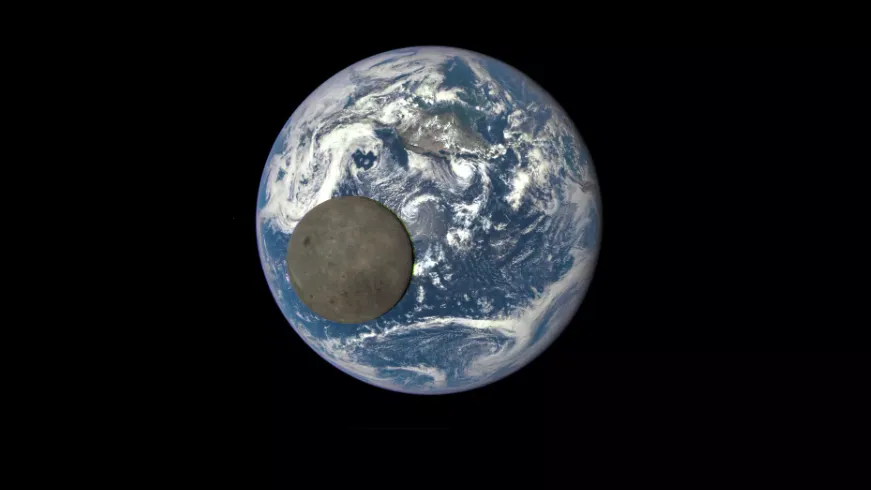
The results are consistent with scientific models that describe the evolution of the Earth–Moon system: the Moon was closer to Earth in the past and has been gradually moving away, which over time has affected Earth's rotation speed and the length of the day.
The study indicates that ancient rocks do not only preserve traces of seas, environments and climates that vanished hundreds of millions of years ago, but can also serve as a "geologic clock" that records changes in the motion of Earth and the Moon and allows scientists to recover details of the planet's deep history.



