Hidden force deep within Earth affects length of day
A hidden force deep within the Earth affects the length of the day
Follow-up - Al-Wasat Iraqi newspaper
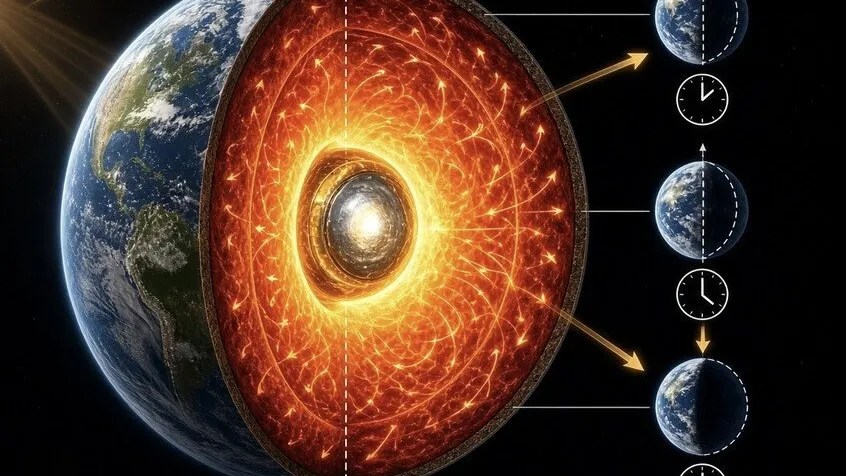
A study by two researchers at the University of Alberta has revealed a hidden force deep within the Earth that may affect the planet's rotation speed, leading to slight changes in the length of the day by fractions of a thousandth of a second.
Physicists Huifeng Chang and Matthew Dumberry analyzed records from the period 1964 to 2019, combining seismic data used to track the rotation of the inner core with models of the motion of the outer liquid core reconstructed from changes in Earth's magnetic field.
After excluding the effects of other factors that can influence Earth's rotation, such as winds, ocean circulation and the long-term influence of the Moon, the researchers compared the remaining changes in day length with the effects of three different mechanisms.
The results showed that the gravitational interaction between Earth's inner core and the surrounding mantle provides the most consistent explanation for the observed changes.
The inner core is an extremely hot, dense sphere composed mainly of iron and nickel, but it is not perfectly spherical. The distribution of mass in the mantle is also heterogeneous.
As the inner core rotates, the interaction between these uneven mass distributions produces what is known as a "gravitational torque," and this torque can slightly speed up or slow down Earth's rotation, altering the time the planet takes to complete one rotation and thus affecting the length of the day.
The researchers linked this effect to a pattern of changes in Earth's rotation extending over about 70 years, and they found that the inner core, despite being solid, can slowly change shape in response to surrounding forces.
Calculations showed that assuming the inner core is perfectly rigid does not match the observed changes well, while the results became more consistent with the data when the model allowed its shape to change gradually. Best estimates indicate these changes occur over a period of 8 to 10 years, while the possible range extends from 2 to 31 years.
The study also provided indications of a possible iron-rich, electrically conductive layer near the base of the mantle about 2 kilometers thick, along with accumulations of hotter material with a chemical composition different from surrounding material. The researchers did not observe these materials directly but inferred their presence through models and calculations.
Despite the importance of the findings, the researchers caution against treating the 70-year pattern as a regular, confirmed cycle, since it remains unknown whether this pattern repeats over time or simply reflects conditions that prevailed during the seven decades covered by the data.
The results also depend on the models used to describe the motion of the inner and outer cores, and some estimates changed by as much as 30% when different models were employed. The study does not explain all fluctuations in day length, particularly changes occurring on timescales of 10 to 30 years, which may be more closely related to forces acting at the core-mantle boundary.
Nonetheless, the study offers a new way to understand what happens deep within the Earth and shows how extremely small changes in day length can reveal information about the movement, composition and behavior of materials in the planet's interior.
Source: News agencies