Netanyahu says he insists on an expanded government and conditions it on excluding parties he called 'supporting terrorism'
The Israeli prime minister said he wants to form a broad national government provided it does not rely on the United Arab List and the Joint List, while the appointment of Gadi Eizenkot to form the government has become nearly certain after Lieberman's move.
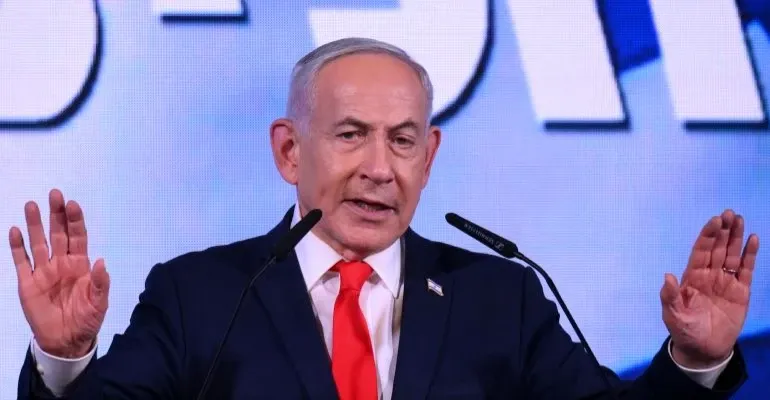
Israeli Prime Minister Benjamin Netanyahu on Monday evening affirmed his insistence on forming an expanded Israeli government with his political partners, stressing the condition of excluding parties he described as "supporting terrorism."
Netanyahu said in remarks to the press that "the public in Israel does not want a government that relies on the United Arab List and the Joint List, two parties that support terrorism and deny the existence of the Jewish state," expressing a desire to form a broader national leadership.
He added that moving toward an expanded government had been possible from the start, noting that "from day one, we extended our hands to form an expanded national government," and that the majority of the Jewish public chose the Likud party and Netanyahu himself to lead the next government.
Responding to questions about his next role, Netanyahu said verbatim: "Whatever government you want me to be part of, I will be its head."
Separately, Israeli media noted that the assignment of former army chief of staff and leader of the "Yishar" party, Gadi Eizenkot, to form the government has become almost certain after Avigdor Lieberman, head of the Yisrael Beiteinu party, announced on Monday that he will recommend President Isaac Herzog appoint Eizenkot.
Lieberman's party won seven seats out of 120 in last week's Knesset elections, but the right-wing bloc led by Netanyahu had been counting on winning over Lieberman after he sharply criticized Eizenkot, hoping Lieberman would shift his allegiance from the opposition ranks (48 seats) to the current governing coalition.