Student protests in France escalate: schools close, universities join and police confront street unrest
Organizers: 260,000 demonstrators in Paris supporting the student protests
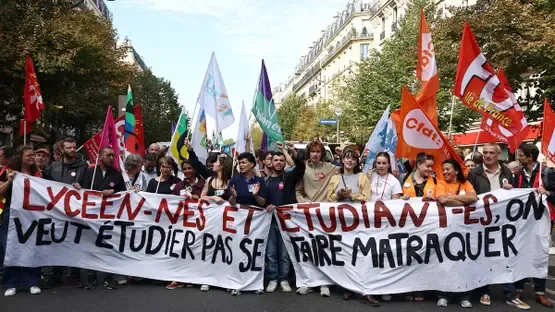
Student protests in France entered a new phase of escalation on Tuesday, October 6, with a nationwide day of protest described as the largest since the movement began in mid-September. Thousands of students, teachers and parents took to the streets in several cities, while hundreds of educational institutions were closed or disrupted amid heavy security deployments in anticipation of further confrontations.
According to organizers, 260,000 people in Paris demonstrated in support of the student protests. The latest figures released by French authorities said morning demonstrations in several regions involved about 86,000 people, while a large gathering in Paris was expected in the afternoon. The Education Ministry announced that 891 educational establishments experienced a total or partial suspension of classes on Tuesday. Other sources say the movement has led to closures or disruptions at an even larger number of schools across the country since it began.

From the student protests in France — Reuters
From schools to universities
A notable development in today’s protests is the clearer involvement of university students. In Clermont-Ferrand, for example, a university campus was closed, while students, faculty and parents joined solidarity marches with high school students. In Paris, Paris-Dauphine University was also reported closed and classes suspended for a full day.
The French Student Union indicates that mobilization within universities is widening, saying on Tuesday morning that more than 57 university sites were closed or blockaded — a figure provided by organizers of the movement rather than an independent government count.
Why are students protesting?
The core demands focus on a shortage of teachers, overcrowded classrooms, deteriorating buildings and equipment, long school hours, and a lack of resources. Students also express concern about their academic and professional futures and about the university admissions system "Parcoursup," which they consider overly complex and insufficiently transparent.
The government says it has already begun to act on some of these issues. Prime Minister Sébastien Lecornu set out five action priorities: speeding up replacement of absent teachers, improving school buildings and preparing for heatwaves, rethinking the organization of the school day, making Parcoursup more transparent, and strengthening student participation in decisions affecting their school life.
Government opens door to dialogue
In a new step announced today, the French Education Ministry opened a national consultation for students via the "Agora" platform, running until October 23, to hear students’ complaints and proposals directly. The ministry said the results of the consultation will be compiled and presented at the end of the month, while the government pledged to present initial practical decisions with funding and a timetable before the end of October.
But government dialogue has not prevented protests from continuing, as student and union organizations say the measures announced so far do not adequately address the scale of the problems that pushed students into the streets. For this reason, mobilization on October 6 became a real test of the government’s ability to contain the movement before it expands further.
Injuries and arrests raise tensions
One of the most serious recent developments was a severe injury sustained during clashes between some protesters and security forces. A 15-year-old boy suffered serious wounds to his hand in Lens in northern France after an explosion of a device used by police to disperse demonstrators, according to authorities and French media; the circumstances of the incident remain under investigation.
In recent weeks there have also been thousands of arrests, most of those detained being minors, while a large number of police officers and protesters have been injured. Authorities say security interventions aim to prevent violence and vandalism, while human rights groups and specialists on student affairs criticize the use of force in dealing with minors.
Paris under watch — and fears of the movement spreading
In the capital, large security forces were deployed ahead of the main march, while cities such as Marseille, Lyon, Nantes, Strasbourg, Toulouse, Rennes and Nîmes saw demonstrations and protests of varying intensity. While some marches passed peacefully, other areas witnessed clashes and the use of tear gas.
These developments come at a politically sensitive time for France, months before the 2027 presidential election. The government is trying to address educational demands while maintaining security and preventing vandalism, at a time when the protests are evolving from local student actions into a broader movement that includes school and university students, teachers, unions and parents.