Astronomers believe they have found a rare planet possibly formed from a star's remnants orbiting a white dwarf
Analyses indicate the planet may belong to a class of “second-generation” planets formed from material ejected by a star in its final stages, and it could be the first of its kind orbiting a white dwarf.
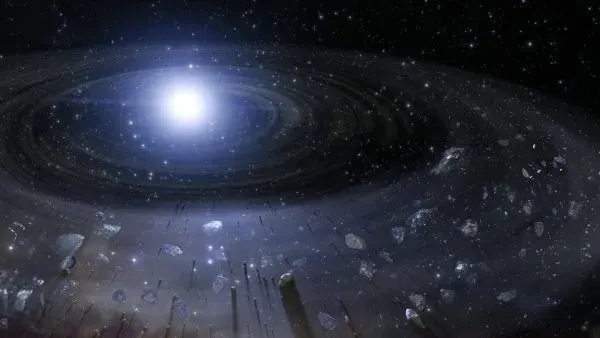
Astronomers believe they have discovered a rare planet of an unprecedented type, and analyses indicate it formed from material left behind by a star during its final stages, in a discovery that could expand scientists’ understanding of how planets form and evolve.
The planet is thought to belong to the class of “second‑generation planets,” which form from material ejected by a star as it nears the end of its life.
Jamie Williams, of the University of Warwick in the UK and the leader of the research team, said this type of planet is extremely rare, noting that observing a planet orbiting a white dwarf is an unexpected discovery and is like finding a world born from the remnants of the star it once orbited.
Candidates of this type have previously been observed around pulsars (ultra‑dense stars), but the new discovery could be the first of its kind — a second‑generation planet orbiting a white dwarf, the remnant core of a star that has exhausted its fuel.
The significance of this discovery lies in the fact that white dwarfs are more common in the universe than pulsars, which raises the possibility that there may be larger numbers of planets formed from stellar remnants than previously estimated and opens new avenues for studying planet formation in evolved stellar systems.



