Qatar and Germany stress importance of LNG and reject closure of the Strait of Hormuz
A joint Qatari-German statement issued Saturday at the end of Emir Sheikh Tamim bin Hamad Al Thani’s state visit to Germany underscores strategic cooperation on liquefied natural gas and rejects any measure that would close the Strait of Hormuz or impede navigation.
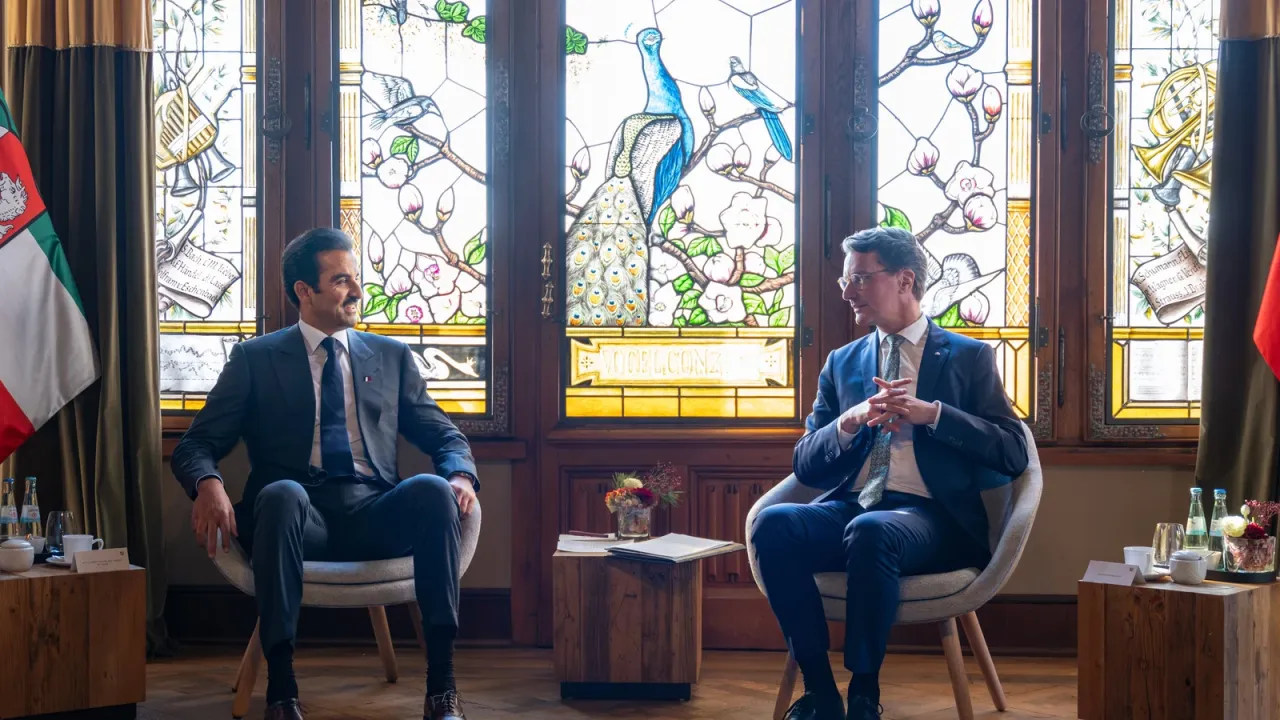
Qatar and Germany said in a joint statement issued on Saturday at the conclusion of the state visit by Emir Sheikh Tamim bin Hamad Al Thani to Germany on 20 and 21 November that cooperation in energy, foremost among it liquefied natural gas, is of strategic importance, at a time when Qatari supplies to Europe face major constraints due to disruptions to navigation in the Strait of Hormuz.
The visit was made at the invitation of German President Frank-Walter Steinmeier. During the visit the Emir held talks with Chancellor Friedrich Merz in Berlin, before meeting today with the Minister-President of North Rhine-Westphalia Hendrik Wüst at Drachenburg Castle in Königswinter, where they discussed expanding economic and investment cooperation and drawing on the state’s industrial and research expertise.
LNG tops the energy agenda
The statement said that, in light of regional and global developments affecting the energy sector, the two countries affirm the strategic importance of their cooperation across various energy fields and related industries, including liquefied natural gas, renewable energy, ammonia, fertilizers and petrochemicals, to ensure secure, diversified and reasonably priced energy supplies for both economies.
The two sides renewed their support for strengthening trade relations between Qatar and the European Union, affirming that reaching a comprehensive free trade agreement between the EU and the Gulf Cooperation Council remains a shared strategic objective.
The statement comes as the European gas market remains under clear pressure: EU storage levels are at around 70 percent of capacity, their lowest level at the start of winter in more than a decade, while Qatari shipments remain far below their usual levels since the outbreak of the war in the region in late February.
Read also: European gas rises toward €87 as attacks on tankers in the Strait of Hormuz resume
Categorical rejection of closing the Strait of Hormuz
On the regional level, the two countries condemned the Iranian attacks that targeted Qatar and regional states, calling them violations of those states’ sovereignty and of international law and a threat to regional security and stability. They also condemned attacks and threats against commercial vessels, and they categorically rejected any action that would close the Strait of Hormuz or impede freedom of navigation there.
The statement stressed the need to keep sea lanes open to international trade without imposing fees or additional payments, and called on Iran to fully cooperate with the International Atomic Energy Agency, affirming that it should not possess nuclear weapons. Germany praised Qatar’s mediation role in several crises, describing it as a strategic partner for peace.
Read also: Trump wants a permanent deal with Iran and a Qatari delegation holds talks in Tehran
€15 billion and security agreements
Economically, the two countries welcomed the announcement that the Qatar Investment Authority will invest €15 billion in Germany over the next five years, subject to the independent investment decisions of the relevant entities. These investments are to focus on supporting the growth and competitiveness of German companies, especially in critical industries and the defense sector, as well as encouraging Qatari investment in energy infrastructure, green technology and advanced manufacturing.
The statement noted that bilateral trade exceeded $2 billion in 2025. The two sides agreed to hold the seventh session of the Joint Committee for Economic and Trade Cooperation in the first quarter of 2027 and to convene the first round of a strategic dialogue early that same year. The visit also saw the signing of a strategic cooperation agreement between the Qatari Ministry of Commerce and Industry and the state of North Rhine-Westphalia to open a regional economic office for the state in Doha, covering areas including the energy transition.
On the security and military side, the two countries signed two security cooperation agreements—one between their interior ministries and another between the German Federal Ministry of the Interior and Qatar’s Internal Security Force—alongside a military cooperation agreement.