TASI falls to 9,986.45 points after brief rise above 10,000 in volatile session
The Saudi stock index ended the session down 2.3% at 9,986.45 points after briefly rising above 10,000, recording gains of nearly 6% over two days with trading around 7.16 billion riyals.
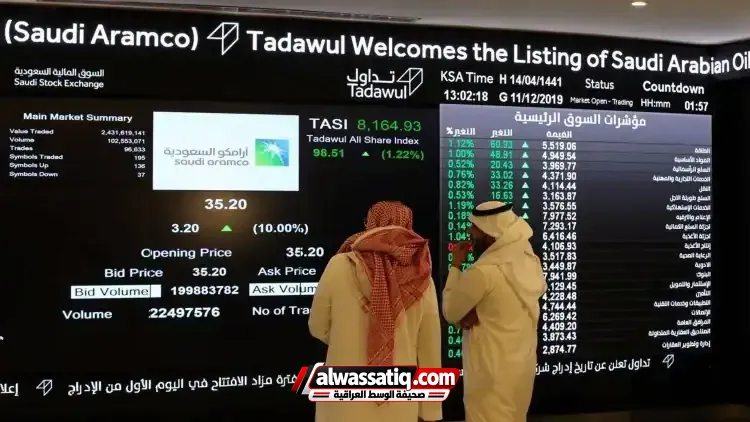
The Saudi stock index trimmed its gains at Tuesday's close to 2.3%, finishing at 9,986.45 points, after rising more than 3% during the session and temporarily moving above the 10,000-point level. The index's gains over Monday and Tuesday accumulated to about 6%, amid trading of roughly 7.16 billion riyals and advances among the majority of listed stocks.
237 stocks out of 273 traded rose, while 30 fell. The market capitalization of listed stocks stood at about 8.98 trillion riyals.
Al Rajhi Bank led the banking sector with a 2.78% rise, and shares of BinDawood, Qassim Cement, Saudi Ceramic, Al-Amar and Shams recorded increases between 9.98% and 10%. National Education, Al Nahdi, Arabian Cement, Alujain and Othaim Markets also topped the list of gainers with rises between 3.2% and 6.5%.
The highest trading values were on Al Rajhi, AlAhli, Saudi Aramco, Alinma and STC. The most active stocks by volume were Americana, Hadid Watani, BATIC, Laden and Anabeeb.
The current market gains came after the index lost about 7.4% over five consecutive sessions before rebounding during Monday and Tuesday and returning to the 10,000-point level, amid improved sentiment and inflows of liquidity into the market.
Mohammed Al Omran, a financial markets expert, said the market saw a strong rebound supported by optimism linked to the possibility of easing military tensions in the region, alongside the return of liquidity and higher trading values, while warning that the continuation of the rise depends on the path of interest rates and corporate profit growth.
Al Omran added in an interview with a media outlet that optimism increased after the meeting of the Makkah Agreement countries in Tehran, which included a delegation featuring the Saudi defense minister, bolstering expectations of a reduction in military tensions and supporting economic stability and regional financial markets after those tensions had exerted strong pressure on the market.
Al Omran noted the index rose by more than 600 points over two consecutive sessions, accompanied by daily trading values exceeding 7 billion riyals, reflecting the return of liquidity that had been waiting for entry opportunities. He said the identity of the buyers—whether large speculators or investors—remains unclear, but the most important signal is the strength of the inflowing liquidity.
Al Omran pointed out that interest rates constitute a second source of pressure on the market after the tensions, with rates at their highest levels in more than 20 years as markets await the US Federal Reserve's decision. He expected interest rates to be held steady at the upcoming meeting, stressing the importance of monitoring the path of rates and inflation alongside developments in military tensions to assess the market's ability to sustain the upward trend.
Regarding valuations, Al Omran said price-earnings multiples have become more attractive after recent declines, but the challenge lies in whether companies can deliver earnings growth in the coming period as quarterly results are released, stressing the importance of tracking profit growth in leading companies because its acceleration could support the market given current valuation levels.
Al Omran also warned that rising interest rates represent a competing alternative to equities, especially when they exceed the average returns companies generate, making the paths of interest rates and earnings growth decisive factors in determining the market's attractiveness and the sustainability of its gains.
Separately, the market index accelerated to a 3.43% rise at the end of Monday's session, reaching 9,761 points. Ghassan Al-Zakeer, chief executive of Me'yar Capital, said the previous index decline was the result of geopolitical uncertainty and not a reflection of economic fundamentals or corporate earnings, noting that the roughly 300-point rise reflects the impact of geopolitical factors more than financial ones.
Al-Zakeer added that SABIC's roughly 16% earnings growth demonstrates the success of the company's restructuring, and he expected the effects of supply-chain disruptions to fade as conditions in the region stabilize.