Pakistan reiterates call for dialogue to reduce regional tensions
Pakistan reiterates call for dialogue to reduce regional tensions
With tensions rising between the United States and Iran and an exchange of threats, Pakistan renewed its position calling for dialogue to calm conflicts in the region.
Pakistani Deputy Prime Minister and Foreign Minister Mohammad Ishaq Dar said in a post on X on Saturday that dialogue and diplomacy are important.
He also urged "continuous communication to address shared regional and international challenges and to limit their economic and social repercussions."
Advancing the cause of peace
He said his country, which has served for months and still acts as a mediator between the American and Iranian sides, "will continue to work closely with Turkey and all friendly countries to drive forward peace, stability and regional prosperity."
Dar said he held a joint meeting with Turkish President Recep Tayyip Erdogan to convey the greetings of Pakistan’s joint leadership and to reaffirm the strategic partnership between the two countries, and that he conducted a series of separate bilateral talks with counterparts from the regional quartet and European countries to discuss bilateral cooperation files and bolster regional stability.

Pakistan’s foreign minister with Turkish Foreign Minister Hakan Fidan
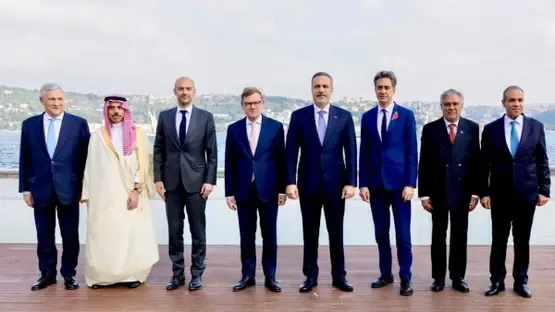
This followed the conclusion of a visit to Istanbul, during which he took part in the sixth ministerial meeting of the "regional quartet" (which includes Saudi Arabia, Pakistan, Egypt and Turkey), followed by a broader meeting with the foreign ministers of the European troika countries and with Britain and Italy.
The foreign ministers of Turkey, Saudi Arabia, Egypt and Pakistan (the "R4" group), together with the foreign ministers of France, Germany, Italy and the United Kingdom, discussed yesterday in Istanbul the conflict between the United States and Iran, as well as the Yemen file and attacks by the Houthi militia, and the safety and freedom of navigation in the Strait of Hormuz, Bab al‑Mandeb and the Black Sea. They affirmed their commitment to continue contributing to diplomatic efforts aimed at enhancing peace and stability in the region and beyond, and to address the security, economic and trade repercussions arising from these issues.
The ministers also agreed on the urgent need to address regional disputes through dialogue, diplomacy and de‑escalation. Relying on relevant United Nations resolutions, they stressed the necessity of finding lasting negotiated solutions to all existing conflicts.