Ministry of Trade launches forum on commerce and economy, affirms its role in market stability
The Ministry of Trade on Saturday launched a conference and forum on trade, economy and corporate social responsibility, saying its bodies play a central role in regulating commercial activity, ensuring goods availability and fair prices.
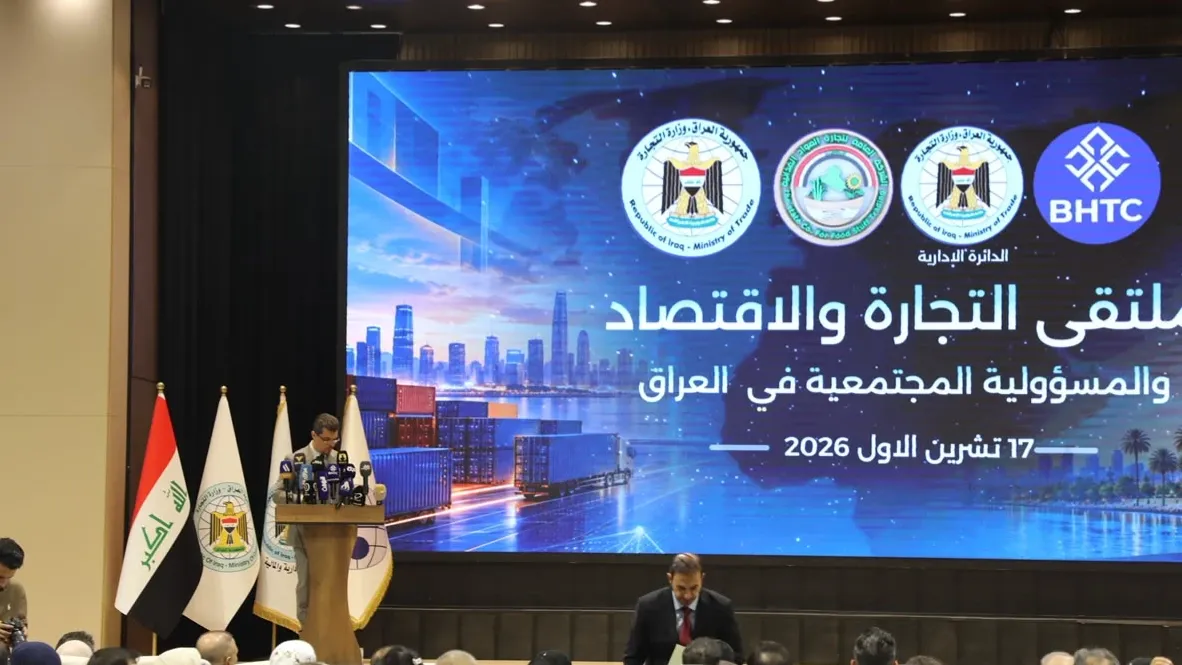
The Ministry of Trade said on Saturday that its bodies play a pivotal role in implementing the country's economic policy by regulating commercial movement, maintaining market stability, ensuring price fairness and guaranteeing the availability of goods to citizens with reliable quality.
Undersecretary Sattar al-Jabri said the ministry's responsibility is not limited to protecting citizens' food needs but extends to supporting society and easing households' living burdens, stressing that these tasks are national and moral responsibilities that require concerted efforts and continuous work to meet citizens' needs.
This statement came during the ministry's launch of the Conference and Forum on Trade, Economy and Corporate Social Responsibility in Iraq, which aimed to discuss the future of trade and the economy in the country and the role of corporate social responsibility in supporting sustainable development and strengthening partnership among various sectors.
Director-General of the Administrative and Financial Department at the ministry, Ibtihal Hashim al-Rubaiee, emphasized the importance of encouraging initiatives and training youth and women, supporting productive projects, and providing a transparent, stable and investment-friendly business environment, considering this a key contributor to sustainable development.
Al-Rubaiee added that corporate social responsibility constitutes one of the fundamental pillars of real development, and that the success of institutions is not measured solely by profits but by their positive contribution to society through creating jobs, supporting education and training, protecting the environment, participating in development initiatives and adhering to principles of integrity, transparency and governance.
She noted that the next phase requires moving corporate social responsibility in Iraq from scattered initiatives to an institutional culture and a sustainable working approach involving state institutions, the private sector and civil society organizations within a national vision that sets priorities and directs resources to the sectors most in need.
Al-Rubaiee stressed that confronting economic challenges requires strengthening dialogue, coordination and partnership among all parties, considering specialized conferences as a space to exchange ideas, present challenges and arrive at practical recommendations that contribute to developing the commercial environment, enhancing food security, supporting production and investment, creating jobs and entrenching the concept of corporate social responsibility.
She pointed out that the conference's outcomes should not be confined to its sessions only, but that its recommendations must be turned into measurable, monitorable and implementable initiatives, partnerships and programs so that citizens feel their practical impact in daily life.
The conference featured panel discussions on the future of the Ministry of Trade, and one of the most prominent speakers was the Prime Minister's financial adviser, Muzhar Muhammad Saleh, who warned against the continued dependence of the Iraqi economy on imports financed by oil revenues and called for redirecting trade policy to support local production and diversify sources of economic activity.
Saleh said private-sector imports of consumer goods and services amount to about $50 billion annually, while total imports including government reach about $70 billion, according to his estimates, adding that about 95% of the Iraqi market's needs depend on imports except for the grains associated with the ration card.
He said these figures reflect an imbalance in the structure of the Iraqi economy, which still relies on oil rent to finance trade while the productive base outside the oil sector remains limited, questioning the Ministry of Trade's ability to operate within a rentier economic system over the long term.
He called for the economic diversification strategy to be reflected in trade policy by shifting it from policies that focus on meeting consumption to policies that stimulate local production, noting the limited linkage between commercial activity and agricultural production and handicraft industries except for grains, and stressing the need to strengthen integration between trade and productive sectors to support job creation and stimulate the economy.
He proposed establishing an authority concerned with trade and production for small and medium activities in agriculture and handicraft industries to support marketing of local products and integrate them into food chains, cooperatives and markets through commercial contracts, and to study employing marketing initiatives to support local products in coordination with the relevant ministry bodies to build a production-oriented trade policy that reduces reliance on imports and oil rent.