Al-Zaidi orders permanent new staff category and pursuit of smuggled funds during heads-of-agencies session
During the first regular session of the Council of Heads of Independent Commissions and Non-Ministerial Bodies, Prime Minister Ali Falih Al-Zaidi ordered the creation of a new permanent staff category and the pursuit of smuggled funds; the council approved decisions on integrity, real estate registration and the Sunni Endowment.
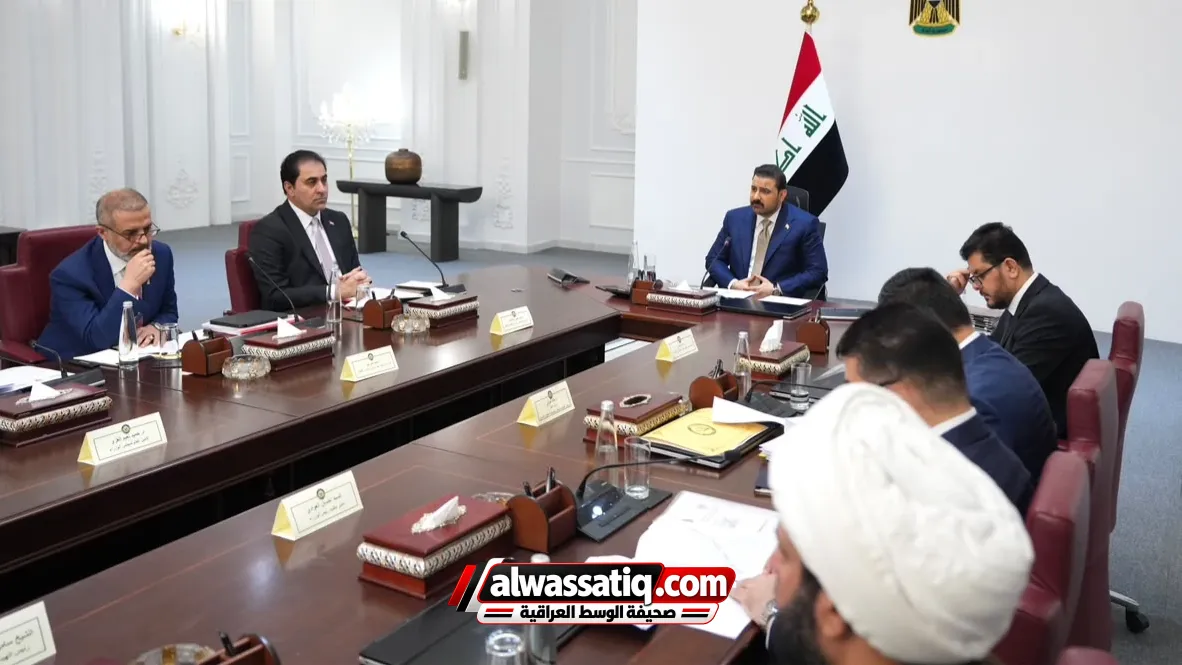
Prime Minister Ali Falih Al‑Zaidi on Wednesday, during the first regular session of the Council of Heads of Independent Commissions and Non‑Ministerial Bodies, directed that a "new category" be made permanent on the payroll and ordered the pursuit of smuggled funds, according to a statement issued by the Prime Minister's Office.
The statement said the session addressed operational and procedural files related to the work of the commissions and ways to resolve obstacles facing them; the council considered the items on the agenda and took the necessary decisions and recommendations regarding them.
Regarding integrity and anti‑corruption, the council voted to approve implementation of Cabinet Decision No. (341 of 2026) concerning the application of the recommendations from the performance evaluation of ministries, entities and governorates in the field of combating corruption and its prevention, and reaffirmed the implementation of the General Secretariat of the Council of Ministers' circular on developing the performance of legal staff.
It was emphasized to establish a mechanism to ensure employees comply with the provisions of the Code of Conduct issued by the Integrity Commission, and to instruct those responsible to submit asset disclosure statements in the independent commissions and adhere to the legally specified deadlines for submission.
The council also approved adopting the real estate registration directorates to automate property ownership data into a unified system, and stressed including a clause in investment and economic agreements with any country where Iraq has funds covered by the Law of the Fund for Recovering Iraq's Funds (No. 9 of 2012) that refers to resolving matters related to smuggled funds or the recovery of those wanted judicially.
The decision called for amending previously concluded international agreements to meet current requirements in this area, notably the Riyadh Agreement on Judicial and Legal Cooperation, the Turkish Agreement on Judicial Cooperation, and the bilateral treaty with Turkey on the extradition of criminals.
The Federal Integrity Commission referred contracts that are required to be exempted from the Public Contracts Implementation Instructions (No. 1 of 2025) to the Cabinet Economic Council for a ruling.
Concerning the work of the Sunni Endowment Office, the council voted that the endowment coordinate with the Federal Public Service Council to state its needs for required specializations, and coordinate with the Ministry of Finance to include a provision in the draft federal budget law to regularize (make permanent) lecturers and security staff.
The council also decided to coordinate between the Sunni Endowment Office and the ministries of Finance, Education and Planning regarding exempting the construction works of Imam al‑A'zam College in Baghdad and the provinces from the contracting methods stipulated in the Public Contracts Implementation Instructions (No. 1 of 2025), and to allocate the necessary funds to rebuild and restore mosques and jamiʿs that were subjected to terrorist attacks.
On the Higher Commission for Hajj and Umrah, the council approved coordinating the commission with the Federal Financial Supervision Bureau to complete audit requirements for contracts, and coordinating with the Ministry of Transport and obtaining the opinion of the Ministerial Energy Council regarding the request for an exemption from Cabinet Decision No. (429 of 2026) related to reducing ticket prices for pilgrims and umrah performers, while taking into account government measures to reduce expenditures and rationalize the commission's foreign delegations.
The Council of Competition and Anti‑Monopoly Affairs agreed to include it in certain government committees responsible for preparing economic policies that affect competition and to enable it to provide opinions, and to coordinate with relevant bodies to prepare a matrix defining each body's role to prevent duplication of decisions and regulatory and supervisory authorities in the market.
The council's decisions stipulate that all government bodies must respond to the Council of Competition and Anti‑Monopoly Affairs to resolve complaints within the specified timeframes, and facilitate and accelerate procedures to establish branches of the council in the southern and northern governorates similar to the Middle Euphrates branch.
The council also voted for the Martyrs Foundation to coordinate with the National Center for Digital Transformation to automate its work, and decided to oblige all government bodies to apply the Arabic Language Safeguarding Law (No. 64 of 1977), with recourse to the Arabic Language Academy when needed.