Al-Shar': Syrian Ports a Choice for Exporting Iraqi Oil; Fates of Both Countries Linked
Syrian President Ahmed al-Shar' told Dijlah satellite channel in a special interview that the fate of Iraq and Syria is linked, and that Syrian ports are among the best outlets and the easiest for exporting Iraqi oil, discussing the Kirkuk–Baniyas line, more than 100,000 transit trucks, security and water files, and the visit to the Sayyida Zainab shrine.
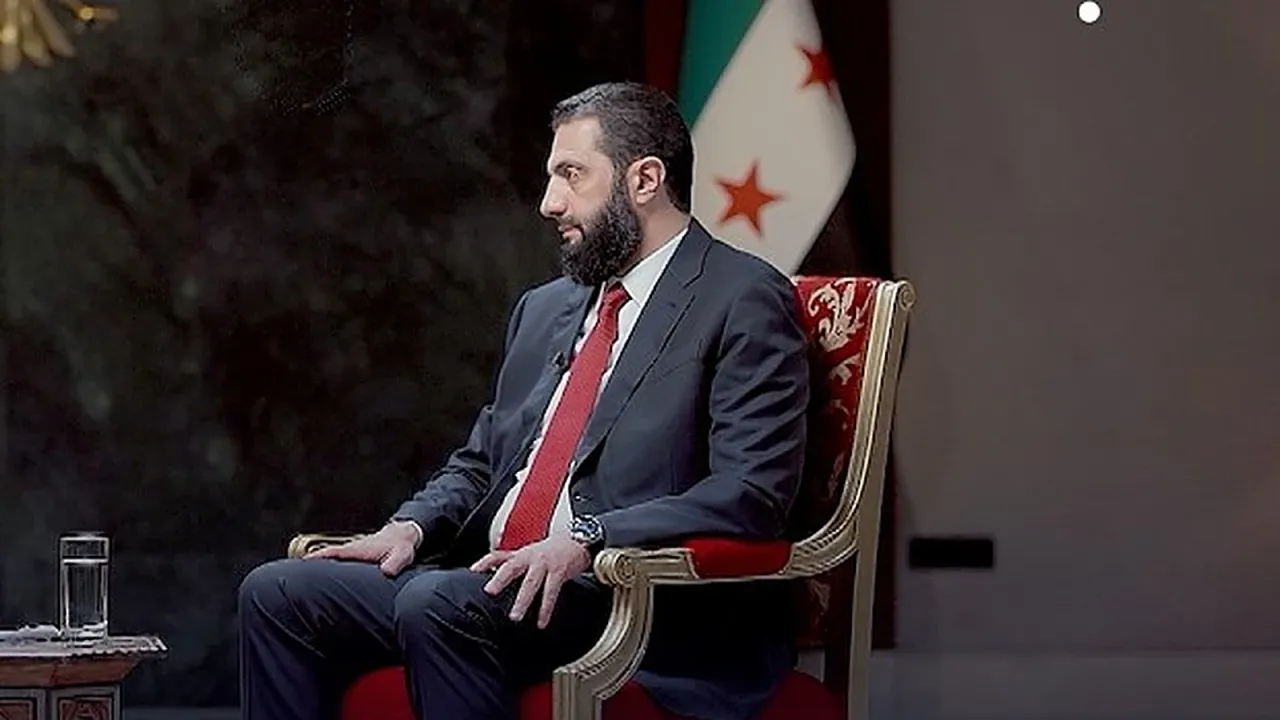
Syrian President Ahmed al-Shar', in a special interview conducted by Dr. Nabeel Jassim on Dijlah satellite channel and broadcast on the evening of Tuesday, October 27, said that the fate of Iraq and Syria is historically, presently and prospectively linked, and that the Syrian ports on the Mediterranean are among the best and easiest outlets for exporting Iraqi oil. He revealed that more than 100,000 transit trucks crossed from Syria to Iraq during the past six or seven months.
The interview, devoted entirely to Iraqi affairs and lasting about 37 minutes, was al-Shar's first appearance on an Iraqi media outlet. He discussed the social and economic relations between the two countries, border and security files, oil and water issues, visits to religious shrines, the file of Syrian detainees in Iraq, as well as his personal experience in Iraq and his message to Iraqis.
Social ties precede politics
Al-Shar' said that relations between states are built on several pillars, the first being popular relations, noting that "the social relations between Syria and Iraq are old and historic," and that sometimes a single tribe is divided between Syrian and Iraqi branches, "and the fates are linked historically, presently and in the future."
He added that relations between states "should not be subject to whims but to rules that regulate this relationship," explaining that relations between the two peoples have remained sound at all times, while relations between political actors have witnessed disputes that negatively affected them.
He said that managing the relationship between two countries the size of Syria and Iraq should begin "from commonalities, not from fears," stressing that "what unites us is far greater than what divides us," and that it is not necessary to agree on everything before moving ahead with economic and social construction.
Al-Faw, Tartus and exporting Iraqi oil
The president explained that Syria represents Iraq's maritime façade on the Mediterranean and the strategic corridor linking the west to Iraq and on to the Arabian Gulf, pointing to several routes under development, including linking Al-Faw port to the Mediterranean via the port of Tartus, the overland routes connecting Saudi Arabia to Syria through Iraq, and routes coming from Turkey to Iraq via Syrian territory.
He said that Iraqi oil needs outlets and corridors for export, and "one of the best and easiest places of access was the Mediterranean ports located in Syria," noting the existence of an old oil transfer line dating back to the 1950s before political disputes halted it.
Kirkuk–Baniyas line and American and regional companies
In response to a question about the Kirkuk–Baniyas line, al-Shar' said that memoranda of understanding were signed in an initial phase in the United States. He recounted that one of the companies investing in Syria offered him last year an investment worth hundreds of millions of dollars; he advised it to go to Iraq, that was before the Strait of Hormuz crisis, adding: "I said the rebuilding of oil lines must return to Banyas; this is what Iraq will most need in the coming stage."
He said these companies discussed the file with the previous Iraqi government led by Mohammed Shia' al-Sudani, but talks remained at a standstill because of the transitional phase and the period before the elections, and later continued with Prime Minister Ali al-Zaidi. He explained that a group of regional and American companies are participating in building an integrated system that includes an oil pipeline, refineries to process the oil, and upgrading port infrastructure.
He pointed out that Iraqi capital has already entered the Syrian market, noting that the first investment in Syria after the new era was likely by Iraqi investors in the cement sector.
100,000 transit trucks and secure borders
On the outcome of cooperation, al-Shar' said: "More than 100,000 trucks have crossed in transit from Syria to Iraq," in addition to more than 40,000 other trucks in the import and export movement between the two countries, "and all of this occurred during the past six or seven months," describing it as very rapid and large growth.
He affirmed that the border between the two countries "is so far secure," and that Syria informs the Iraqi government of any concerns it has, and the Iraqi government notifies Damascus of any observations, with coordination on the border proceeding effectively. He explained that Syria seeks borders free of security breaches, smuggling and the risks posed by undisciplined armed formations in concert with the Iraqi government.
He added that Damascus spoke from the first moments about concentrating arms in the hands of the state, and that this was achieved by agreement, and that the file of northeast Syria, which included bases for four major countries—Britain, France, the United States and Russia—alongside the Syrian Democratic Forces (SDF), ended with the integration of these forces into the Syrian state.
Iraqi government stance and al-Zaidi's visit
Al-Shar' praised the stance of the central government in Baghdad, saying its policy was positive toward Syria from the first moments, despite parties that tried to push it toward negative decisions, and that the previous government's orientation under al-Sudani was correct, and that reality corrected the wrong course some political forces had pushed toward.
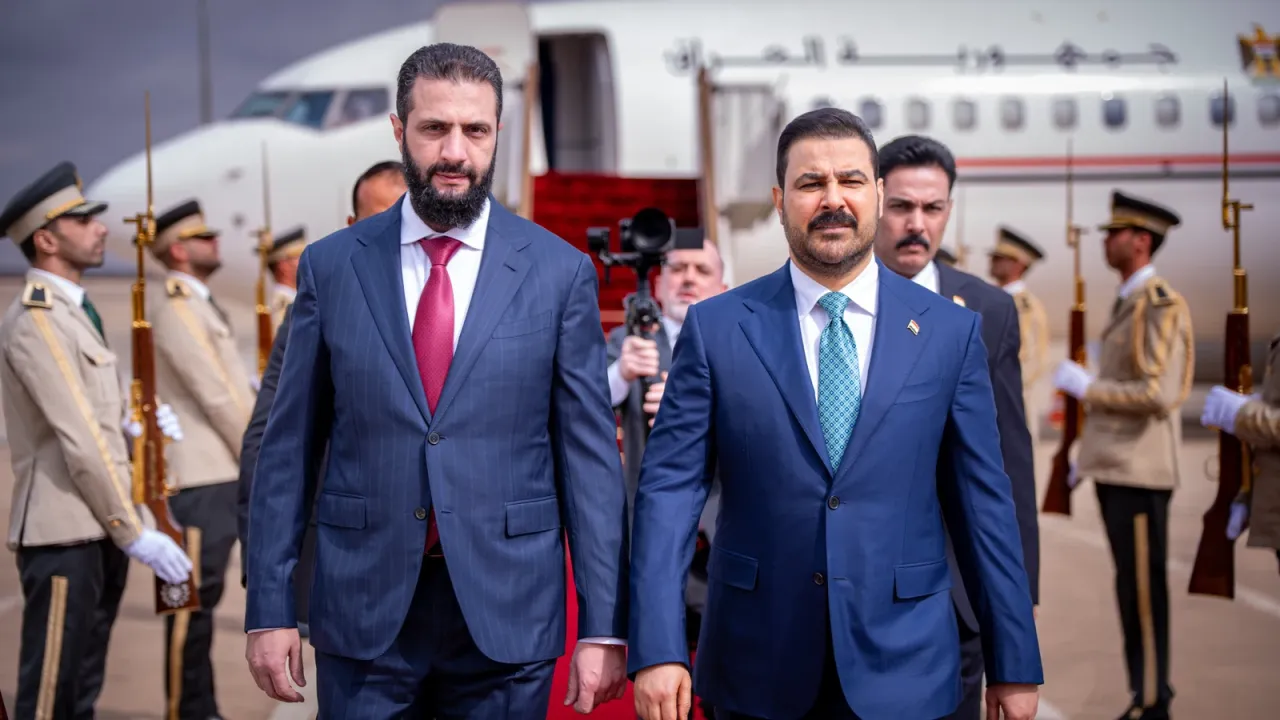
He welcomed Prime Minister Ali al-Zaidi's visit to Syria, recalling that Damascus was among the initiators in congratulating him upon assuming the premiership, and considering that the past year and a half witnessed the building of something good in Syrian–Iraqi relations, especially on the economic side, and that "the stability of Syria benefits Iraq just as the stability of Iraq benefits Syria."
He said al-Zaidi "appears determined to fight corruption," calling on Iraqi society to support this approach, and announced Syria's support for the option of concentrating arms pursued by the prime minister, adding that "when the state builds a unified and strong army it is a strength for everyone and a protection for everyone," and that the decision over peace and war is an instrument the state should not cede.
ISIS and the file of Syrian detainees
On the security file, al-Shar' said that the danger posed by ISIS "has gradually diminished," while adding that "this does not mean we have reached a state of sufficient reassurance," stressing the importance of coordination between the two countries because division and collapse in any country provide a suitable environment for the spread of this ideology.
Regarding the detainees handed over by coalition forces from Syrian prisons to the Iraqi government, he clarified that among them are a number of Syrians numbering almost 3,000, and that discussions took place with the President of the Supreme Judicial Council in Iraq, Faiq Zaidan, who visited Syria and met with the Ministry of Justice to set up a program to categorize them, noting that some of them have no connection to the organization, and stressing that Syria must assume responsibility for its citizens "and not shift this burden to Iraq."
Water and agriculture as a food basket for the region
Al-Shar' described water as the most important common interest between the two countries, explaining that the Euphrates River passes through a large part of Syria, while the Tigris passes through a small portion of it as a border case between the two countries. He called for viewing the agricultural area in Syria and Iraq "as the food basket for the entire region."
He said that between the two countries there are approximately 80 to 100 million dunams capable of feeding between 100 and 130 million people, and that studies carried out in cooperation with Denmark and the Netherlands on modern agricultural techniques that rationalize water consumption showed the possibility of increasing agricultural production by between 50 and 70 percent in some areas, calling for a unified strategy to manage water shares and agricultural investment.
Visit to the Sayyida Zainab shrine
On Iraqis' visits to the Sayyida Zainab shrine, al-Shar' said that "the matter is permitted" and that Syria objects only to ensuring the security conditions are safe, revealing that Syria was ready for this months ago but attempts by groups to provoke sectarian tensions were foiled and those involved were arrested.
He affirmed that Syria does not view its relationship with Iraq "from a sectarian or ethnic perspective," and that shrines important to the noble Shia community are accessible and are also visited by Syrians, adding that "receiving delegations that come from Iraq, God willing, will be in the near future."
His experience in Iraq and his message to Iraqis
Al-Shar' spoke about his personal experience in Iraq, saying he entered Iraq about a week to ten days before the arrival of U.S. forces in 2003, that he was 18 years old, and that he went alone without any organizational affiliation motivated by a sense of "chivalry" to confront the U.S. forces. He said he entered prison in Iraq around 2005 and was released in 2011, returning to Syria with the start of the revolution, and that he did not participate in the sectarian fighting that Iraq witnessed in 2006. He said: "In my life I have not attacked any civilian or unarmed person," adding that "there is a big difference between a fighter and a killer."
He described Iraqis as "people of honor, generosity, chivalry and boldness," and in his message to them said that the two countries are going through a dangerous phase but face "a historic and very precious opportunity" to regain decision-making in the region, noting that in Syria and Iraq together there are more than 10 million refugees in Western countries and calling for cooperation to prepare the appropriate climate for their return.
Al-Shar' concluded by saying that societies in both countries have suffered for 60 to 70 years from coups, conflicts and wars, and that Iraq has not seen stability since 2003, considering that "23 years are sufficient to build a strong state," and that today represents "the best possible opportunity" for Iraq and Syria.