Coordinating Framework Considers Establishing a 'State Leadership Council' to Oversee the Government
Iraq's Shiite Coordinating Framework is discussing a proposal to convert its loose alliance into a permanent political leadership by forming a 'State Leadership Council' to monitor the government through specialized committees — a move analysts say aims to curb Prime Minister Ali al-Zaidi's scope and reshape power balances within the Shiite coalition.
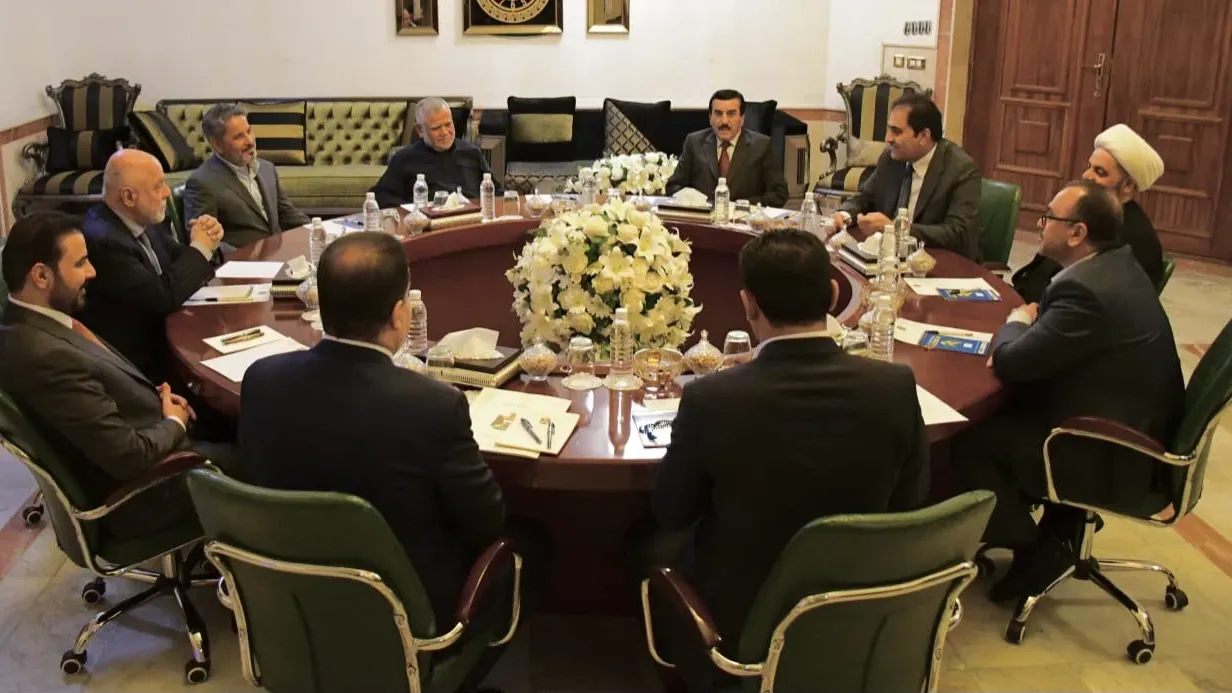
The Coordinating Framework uniting Shiite forces in Iraq is studying a proposal to transform its political alliance from a loose coalition into a permanent political leadership with direct influence on government decisions, by forming a “State Leadership Council” proposed by the head of the Iraqi Supreme Islamic Council, Humam Hamoudi, last August.
The proposal stipulates that the council would monitor the government's work through specialized committees affiliated with the Framework, and that it would be an internal body separate from the broader State Administration coalition that includes Shiite, Kurdish and Sunni forces supporting the government.
Although there is no clear constitutional basis for the proposed council, a political source close to the Framework said, “the council could gradually become the reference for major decisions in Baghdad.”
Analysts say the proposal could be an attempt to limit Prime Minister Ali al-Zaidi's margin of maneuver, particularly after his anti-corruption campaign and his call to confine weapons to the hands of the state — two steps that have worried factions within the Framework's leadership.
Under this conception, the prime minister's role could change from policymaker to implementer of decisions taken inside the Framework, while the proposed council's effect would extend beyond al-Zaidi personally to a reorganization of the balance of power within the Shiite alliance itself.
Commenting on the alliance's internal situation, Ihsan al-Shammari, head of the Political Thinking Center, said the Shiite coalition faces an unacknowledged crisis amid competition between generations and differing interests, and that the proposed council could provide a framework to settle these disputes, keep the leader of the Shiite National Current, Muqtada al-Sadr, out of power, and regulate the position of new forces within the alliance.
For his part, Hamed al-Sayyid, deputy secretary-general of the Opposition National Line current, considered the council's creation an attempt to close the door on any potential return of the Sadr current and to revive the idea of a “political majority,” as well as to narrow decision-making within the Framework to forces with parliamentary weight.
Al-Shammari warned that the Framework does not see itself merely as the largest parliamentary bloc entitled to name the prime minister, but as the government in practice — a stance consistent with Badr Organization leader Hadi al-Amiri's position that major decisions on disarming factions should be a collective decision of the ruling coalition, not a decision by the government alone.
Al-Zaidi's room for maneuver appeared limited since he was chosen as prime minister last April as a compromise after the dispute between nominations of State of Law coalition leader Nuri al-Maliki and former prime minister Mohammed Shia' al-Sudani, although U.S. approval and judicial cover gave him some space to act when he assumed office in May.
But his anti-corruption campaign, launched in late June under the name “Sulat al-Fajr” (Dawn Offensive), faced objections from parties within the Framework, and al-Shabandar said al-Zaidi “has more enemies than allies” inside the coalition.
His margin for maneuver seemed narrower on the weapons file; after al-Zaidi announced on July 14 that no party would be permitted to carry weapons outside state control after September 30, reports on August 25 said a tripartite committee including al-Maliki, al-Sudani and al-Amiri was negotiating with the factions over their arms.
On September 21, in a press interview, al-Zaidi proposed a 90-day halt to attacks by the factions starting September 30, followed by the handing over of weapons to be completed on June 30, 2027 — extending the deadline he had previously set by nine months.
Reactions to the anti-corruption campaign and the rollback of the disarmament timetable reflect the limits of al-Zaidi's power, while creating a “State Leadership Council” to monitor the government through the Framework's committees would turn those limits into a permanent political mechanism.