Creation of new ministries and split of Culture and Tourism spark debate in Iraq after exchange-rate change
After the official dollar exchange-rate adjustment, a former MP revealed understandings to create two ministries and to split the Ministry of Culture and Tourism, while officials and analysts warn of administrative and financial repercussions amid a growing deficit.
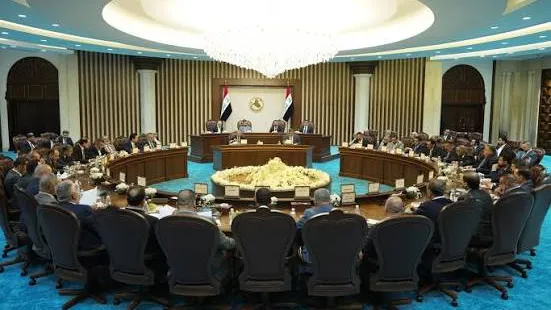
Two days after the official dollar rate was raised, former MP Amir al-Mamouri announced on Friday political understandings to establish two new ministries, one of them for artificial intelligence or for digital investments, and to split the Ministry of Culture and Tourism into two independent ministries, one for culture and the other for tourism. He said the distribution is being carried out according to quota-sharing to appease political blocs and asked: "Where is the financial crisis then?"
Separately, MP Mukhtar al-Mousawi said on 25 June that the creation of ministries of tourism and governance remains under discussion and study, and that resolving it requires an administrative, financial and legal assessment away from considerations of political appeasement.
These proposals come as the new official dollar rate took effect, reaching 1,520 dinars for the end beneficiary as of Wednesday, compared with 1,320 dinars previously, after the Cabinet decided in its session on Tuesday, 6 October, to adjust the exchange rate. The move has raised concerns about pass-through to the prices of goods and services and a decline in citizens' purchasing power.
Former planning minister Nuri al-Dulaimi said Iraq does not currently need new ministries as much as it needs to restructure existing ministries and institutions, stressing that priority should be given to addressing administrative imbalances and improving the efficiency of the government apparatus. Al-Dulaimi cited measures taken by Haider al-Abadi’s government in 2015—such as abolishing the posts of vice presidents and deputy prime ministers and reducing special protections—as steps taken in response to reform demands and to combat bloated structures.
Al-Dulaimi warned that expanding the creation of new agencies and institutions could increase disguised unemployment and raise operational burdens, noting that establishing a new ministry does not only mean the minister’s salary but also deputies, advisers, directorates, offices, protections and operational budgets that add pressure on public finances.
Financial indicators reflect the severity of the budgetary pressures. According to data from an economic observatory, the fiscal deficit up to the end of October 2025 reached about 24.68 trillion dinars, while total revenues reached about 103.5 trillion dinars, with non-oil revenues not exceeding 10.3 trillion dinars. Current expenditures, including salaries and service provision, amounted to about 96.4 trillion dinars over the same period.
Former MP Hussein Arab said that creating a ministry for e-governance or artificial intelligence could be an important administrative step if it aims to address weak electronic linkage between state institutions, develop government services and raise administrative efficiency. He pointed out that the proposed ministry could rely on existing staff and expertise within government institutions by transferring some personnel to it instead of creating an entirely new apparatus.
By contrast, former MP Muhammad Khalil ruled out an urgent administrative need to create new ministries, and said that the desire of some political blocs to join the government could drive an expansion in the number of portfolios, increasing operational spending and putting pressure on the budget. He nonetheless stressed the importance of representing Iraq’s communities, noting that he had previously called for creating a Ministry of Components to represent Yazidis, Christians, Mandaeans, Feyli Kurds and others.
Political analyst Majashi al-Tamimi says the priority should be to reduce administrative bloat, restructure state institutions, adopt austerity policies and improve the efficiency of existing institutions, rather than creating additional ministries that increase positions, salaries and allowances without guaranteeing tangible results.
Political discussions over government formation continue. The Al-Zaidi government comprises 23 ministerial portfolios; 14 ministers won confidence since May, while nine portfolios remain vacant and are currently run in an acting capacity, among the most prominent being defence, interior, planning, reconstruction and housing. The State of Law Coalition led by Nouri al-Maliki nominated Yasser Sakhil for the interior ministry, and Haider Baha, who currently serves as dean of the College of Pharmacy at the University of Al-Nahrain, was nominated for the higher education ministry.