Washington, Tokyo and Seoul renew commitment to North Korea denuclearization and sign Pacific Arctic partnership
U.S., Japanese and South Korean foreign ministers in Atlanta reaffirmed commitment to the complete denuclearization of North Korea, urged Pyongyang to reduce tensions, signed a tripartite Pacific Arctic partnership memorandum, and rejected economic coercion.
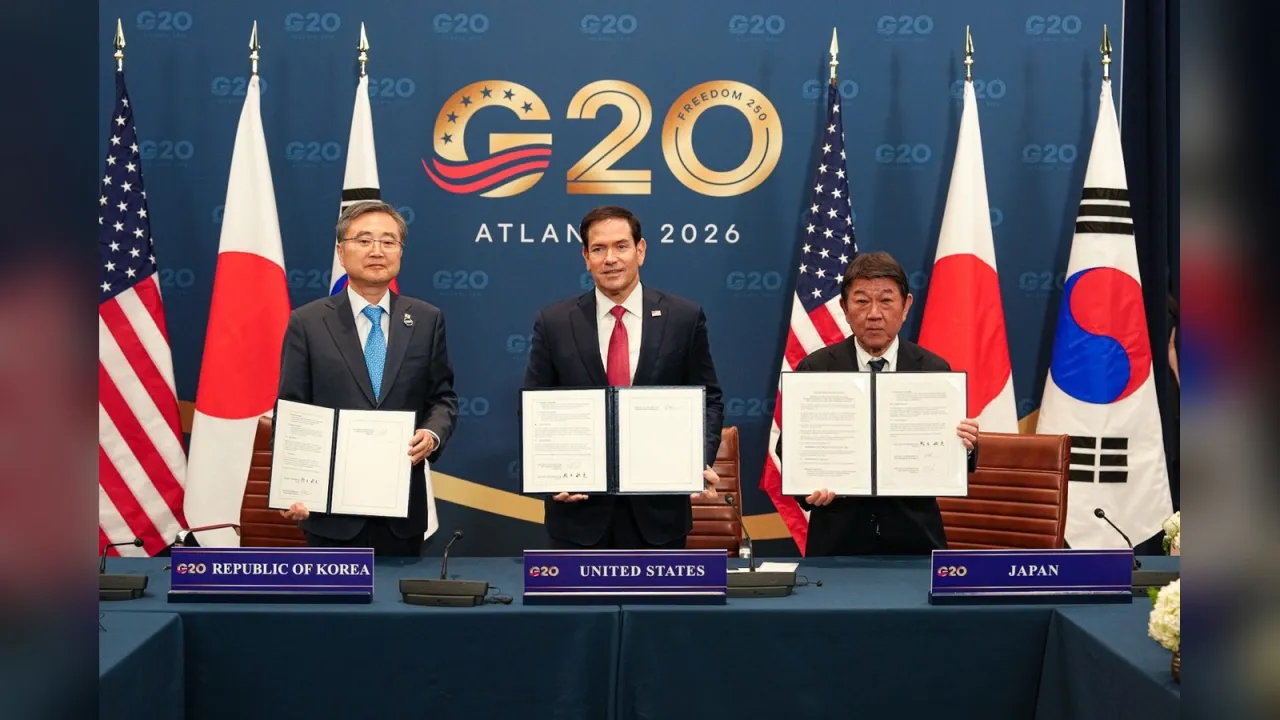
U.S. Secretary of State Marco Rubio, Japanese Foreign Minister Toshimitsu Motegi, and South Korean Foreign Minister Cho Hyun held a trilateral meeting on Friday, October 30, 2026, in Atlanta, Georgia, on the sidelines of the Group of Twenty foreign ministers' meetings. It was the fourth meeting of the three ministers this year and came about a month after their last meeting on the sidelines of the United Nations General Assembly in New York.
According to a statement issued by the U.S. State Department after the meeting, the three ministers "renewed their steadfast commitment" to the complete denuclearization of North Korea and to the full implementation of United Nations Security Council resolutions, including prohibiting support from any sources that finance Pyongyang's nuclear and missile programs.
Call for Pyongyang to reduce tensions
South Korea's foreign ministry said the ministers exchanged views on recent developments on the Korean Peninsula, invited North Korea to join efforts to reduce tensions and establish a lasting peace in the region, and agreed to maintain a strong deterrent through close coordination while continuing to pursue peace, stability and denuclearization through dialogue and diplomacy.
South Korean Foreign Minister Cho Hyun said his country will continue its role in building a peace architecture on the Korean Peninsula and in resuming dialogue between Washington and Pyongyang, noting that the three countries have held three foreign-minister-level meetings over the past four months. This comes days after Seoul's proposal to hold military talks with the North to demarcate the border line and prevent clashes.
The ministers also praised the work of the multilateral sanctions-monitoring team in uncovering North Korea's violations of and circumventions of Security Council resolutions, and agreed, according to the Japanese side, to cooperate in countering cyber activities carried out by Pyongyang to finance its nuclear and missile programs, and to work to resolve the issue of Japanese citizens who were abducted.
Taiwan Strait and South China Sea
The ministers stressed the importance of maintaining peace and stability in the Taiwan Strait, while the U.S. minister raised what he described as China's efforts to impose control over the South China Sea and its behavior in the East China Sea and the Yellow Sea, along with Russia-China cooperation that he said undermines peace and stability in the Indo-Pacific. This comes days after Taiwan's warning about the deployment of 53 Chinese vessels, including the aircraft carrier Liaoning from southern Japan to the Philippines.
Tripartite partnership in the Pacific Arctic
The three ministers signed a memorandum of cooperation during the meeting to launch the "Tripartite Partnership for the Pacific Arctic," which aims to explore maritime cooperation and economic partnership in the polar region bordering the Pacific. Under the memorandum, the three countries will establish a trilateral working group to deepen shared understanding of maritime safety and emergency-response activities in the region, and to exchange information on economic partnership opportunities, including through the Arctic Council.
Rubio, commenting on the signing, said that protecting the Pacific Arctic region is "a shared priority" with Japan and South Korea, at a time when China and Russia are enhancing their cooperation in developing and using polar navigation routes.
Economic security and supply chains
On the economic front, the ministers emphasized the importance of economic security, renewed their joint rejection of economic coercion and the weaponization of supply chains, and reviewed implementation of the tripartite cooperation memorandum on deploying small modular reactors that was signed in Ankara on July 7. They also agreed to continue strengthening cooperation to diversify supply chains for critical minerals, and in artificial intelligence and emerging technologies, amid a shared recognition of the vulnerability of supply chains in the face of the global energy crisis.
The ministers concluded their meeting by reaffirming the commitments in the joint trilateral statement issued on September 21, 2026, and pledged to continue trilateral meetings at all levels. On the sidelines, the South Korean minister held a separate meeting with his U.S. counterpart to discuss bilateral relations, high-level visits and visa issues.