Risks of Egyptian military intervention to support Saudi Arabia and its impact on the economy and the Suez Canal
Egypt's parliament is set to vote on authorizing President Abdel Fattah el-Sisi to provide defensive military support to Saudi Arabia, amid debate over the mission's limits, costs and risks to Egyptian forces, Red Sea navigation, Suez Canal revenues and the Egyptian economy.
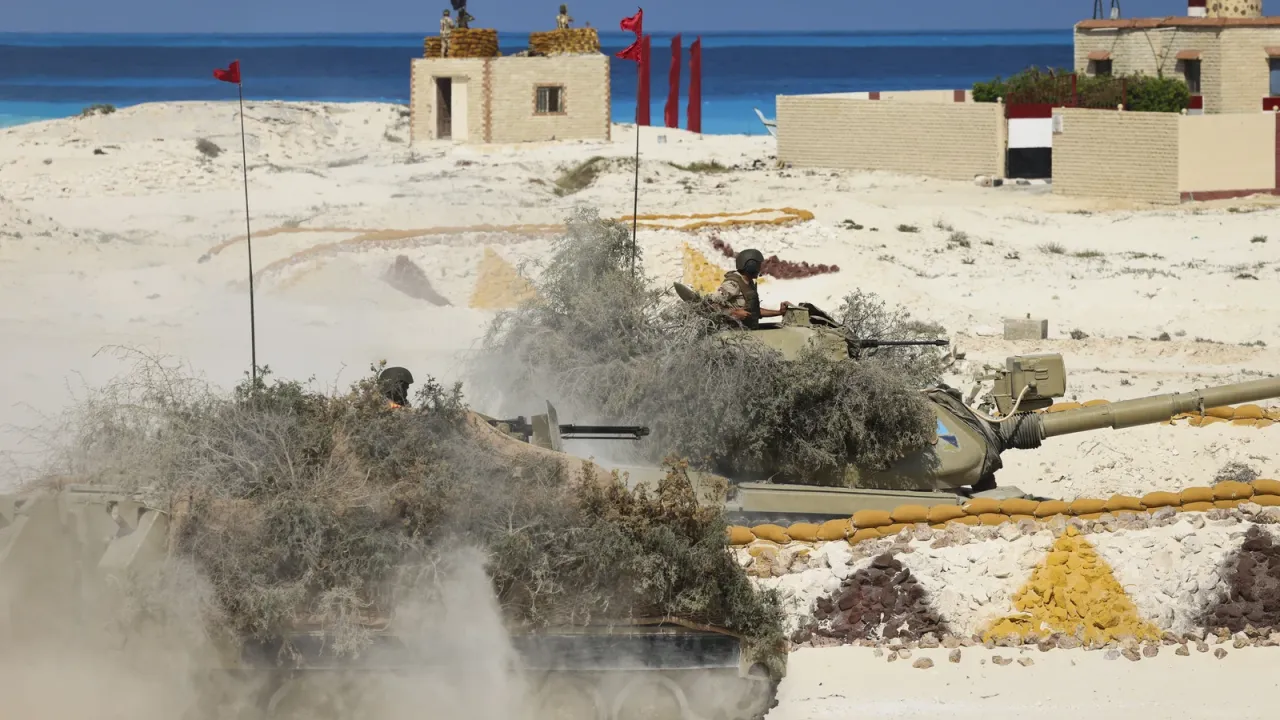
Egypt’s House of Representatives is due to vote on 26 October on President Abdel Fattah el-Sisi’s request to authorize him to provide defensive military support to the Kingdom of Saudi Arabia if Riyadh requests it, a move that could bring Egypt closer to direct involvement in one of the region’s most complex conflicts and opens a broad debate about its political, military and economic gains and risks.
From the authorization request to the vote
Last Saturday, during a graduation ceremony at the Egyptian Military Academy, el-Sisi asked that parliament convene in an emergency session to grant him the authorization, stressing that Egypt will not allow Saudi security to be compromised and that he was not speaking "about confronting or attacking any party" but only about defense. The following day the National Defense Council announced Egypt’s full solidarity with the Kingdom and the provision of all necessary and possible forms of support.
The House of Representatives held two emergency sessions before postponing the vote to 26 October. Article 152 of the Egyptian constitution stipulates that the president may not send the armed forces on a combat mission outside the state’s borders except after consulting the National Defense Council and obtaining the approval of the House of Representatives by a two-thirds majority of members, meaning at least 398 votes out of 596 deputies. Authorization does not automatically mean forces will be sent; any deployment remains conditional on a formal Saudi request that has not been announced so far.
The limits of the mission as outlined by el-Sisi
El-Sisi was keen to set the ceiling of the mission, stressing that Egypt’s military effort is to defend the Kingdom’s territory and borders and does not include an attack on Yemen, and that Egypt is ready to defend any Arab state that requests it. Military analysts believe any potential Egyptian role would likely focus on air defense, naval support and protection of coasts and shipping lanes, with the deployment of ground forces inside Yemen considered unlikely.
Military risks and an Iranian warning
The main military risks include Egyptian forces being targeted by missiles and unmanned aerial vehicles, tools that have proven effective in the ongoing conflict, and the possibility that a defensive mission could slide into a longer and wider confrontation than planned. In this context, Iranian Foreign Minister Abbas Araghchi warned that Egypt’s or any other party’s engagement in the war in Yemen would make settling the crisis "more difficult."
Observers point to the July attack on two vessels by a drone at the port of Damietta, for which responsibility has not been determined, as evidence that Egypt is not immune from the spillover of surrounding conflicts.
The Red Sea, the Suez Canal and the economy
Economically, the Suez Canal remains at the top of concerns, as Egypt has lost billions of dollars in revenues since shipping disruptions in the Bab al-Mandeb began in 2023. Any expansion of confrontation in the Red Sea could push more ships to avoid the route, directly hitting the country's hard currency revenues.
At the same time, Egypt and Saudi Arabia have deep economic ties: the Kingdom is a major financial partner for Cairo and is scheduled to deposit $5.3 billion with the Central Bank of Egypt during this month, and it hosts a large Egyptian expatriate community. Analysts say that securing navigation in the Red Sea is a shared interest for both countries and that Cairo’s security and economic considerations are closely intertwined.
Domestic debate and regional calculations
Domestically, the Egyptian Social Democratic Party announced it had instructed its parliamentary bloc of about 11 deputies to abstain from the vote, while affirming solidarity with Saudi Arabia and calling for greater clarity on the mission’s objectives, duration, costs and the risks to Egyptian soldiers. The move is expected to receive majority support in parliament.
Regionally, Cairo seeks not to appear distant from defending the Kingdom, after both Turkey and Pakistan made similar commitments under a defense agreement they signed with Riyadh in August, while Egyptian diplomacy continues to call for de-escalation, a halt to hostilities, the protection of navigation and the launching of a political track to end the crisis.