Hegseth and Koizumi agree in Cebu to boost deterrence and apply effective denial in the First Island Chain
U.S. Defense Secretary Pete Hegseth and Japanese Defense Minister Shinjiro Koizumi agreed in Cebu, Philippines, to increase defense investment, strengthen deterrence and implement an "effective denial" defense in the First Island Chain amid rising Chinese military activity, while Hegseth proposed a new defense cooperation framework between Washington and ASEAN.
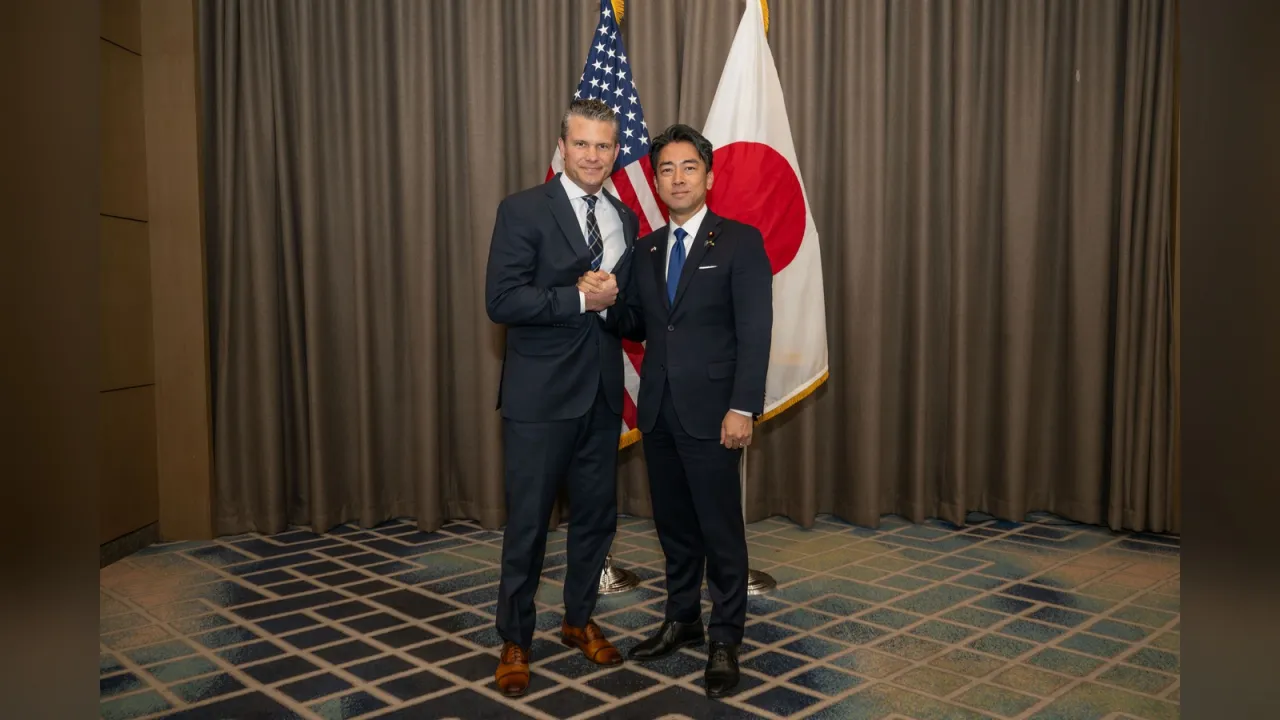
U.S. Defense Secretary Pete Hegseth and Japanese Defense Minister Shinjiro Koizumi agreed on Wednesday, 28 October 2026, to strengthen the deterrent capabilities of the U.S.-Japan alliance, increase defense investment, and work to implement what they described as an "effective denial defense in the First Island Chain," during a bilateral meeting in Cebu, Philippines, on the sidelines of ASEAN defense ministers' meetings, amid rising Chinese military activity in the region.
The First Island Chain stretches from the Nansei Islands in southwestern Japan, through Taiwan, to the Philippines, and is considered the first line of contact between China's coast and the open Pacific Ocean. The concept of "denial defense" is based on preventing an adversary from achieving its military objectives even if it initiates an attack.
Live-fire exercises and cooperation in ammunition production
The U.S. Defense Department said in a statement about the meeting that the two sides affirmed the alliance's indispensable role in maintaining peace and stability in the Pacific, and discussed enhancing shared access and military presence and conducting realistic exercises and maneuvers across Japan, including live-fire drills, as well as accelerating measures that allow more flexible and resilient operations, such as the flexible use of facilities and training for distributed operations.
Hegseth welcomed Tokyo's efforts to strengthen its defense industrial capabilities, and the two ministers pledged to continue close coordination on the production of critical munitions. Japan's Defense Ministry said the sides also agreed to continue strengthening cooperation to prevent cyberattacks from seriously affecting citizens' lives, economic activity, and the security of both countries, against the background of a series of breaches and personal data leaks.
Review of Japan's security documents and the Okinawa case
Koizumi briefed his U.S. counterpart on ongoing work to review Japan's three main security documents before the end of this year, a review expected to make denial capabilities a central concept in Japan's defense policy. The two ministers also confirmed continued consultations on measures to prevent recurrence of incidents after the arrest of a U.S. Marine in Okinawa Prefecture this month on suspicion of stealing a local woman and killing her.
In a related context about sensitivities surrounding bases in Japan, the Japanese government had referred to parliament a draft law that prevents foreign governments from owning land near military bases.
Hegseth proposes a defense framework with ASEAN
In an informal meeting with ASEAN defense ministers in Cebu, Hegseth proposed drafting "a framework for defense cooperation between the United States and ASEAN," calling the proposal "ambitious" without revealing details, and saying it would be "a practical framework to guide our cooperation over the coming years, which are of great importance." He added: "We will not agree on everything, and we do not need to," calling for cooperation where mutual interests meet, and for strengthened maritime domain awareness and advanced maritime coordination.
He said Washington is ready to begin work on this framework with Singapore holding the chair of next year's expanded ASEAN defense ministers' meeting.
U.S.–South Korea meeting and Chinese absence
Hegseth also met in Cebu with South Korean Defense Minister Kang Shin-chul, in their first bilateral meeting since Kang took office in September. South Korea's Defense Ministry said Hegseth reiterated his country's commitment to transfer wartime operational control to Seoul, and the two sides agreed to work closely to ensure the transfer is carried out smoothly and in a timely manner, with ministerial talks in Washington in December and the annual security consultative meeting between the countries postponed to early 2027.
In contrast, China's Defense Ministry announced that Beijing will send its military attaché at its embassy in Manila to represent it at the expanded meeting instead of Defense Minister Dong Jun, in an absence that coincides with the convening of the Fifth Plenary Session of the Communist Party of China's Central Committee, and amid ongoing disputes between Beijing and Manila in the South China Sea.
The main session of the 13th ASEAN defense ministers' expanded meeting is scheduled for Thursday, 29 October, with the ASEAN's 11 member states and its eight dialogue partners participating: the United States, China, Japan, South Korea, Russia, India, Australia and New Zealand. On the sidelines of the meetings, the defense ministers of the United States, Japan, Australia and the Philippines held a quadrilateral meeting.