Israelis begin voting in first general election since October 7 attack
Voting began on Tuesday to choose members of the Knesset for the first time since the October 7, 2023 attack, in a close race between Benjamin Netanyahu and Gadi Eizenkot.
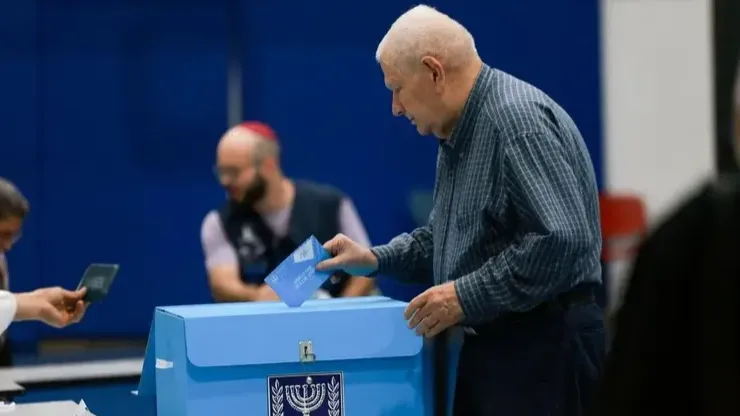
Israeli voters went to the polls on Tuesday to cast their ballots in a general election—the first since the October 7, 2023 attack—in a contest marked by fierce competition between current Prime Minister Benjamin Netanyahu and his main opponent, former chief of staff Gadi Eizenkot.
About 7.3 million Israelis are eligible to vote to choose the 120-seat Knesset. Any government needs 61 seats for a majority. Opinion polls before voting showed a close race between the two main camps without indicating that either could guarantee that threshold, making post-election coalition negotiations decisive in determining the next prime minister.
The party scene is divided among right-wing, centrist and left-wing parties, alongside Arab and religious parties. Security issues top voters' agenda, alongside the failures of October 7, the war in Gaza, the issue of compulsory military service, and the future relationship between religion and the state.
Benjamin Netanyahu leads the Likud party, which represents the right and advocates nationalist positions and liberal economic policies. Netanyahu has served long terms as prime minister since 2009 and leans on his experience in forming governing coalitions, but he faces criticism over his government's failure to prevent Hamas's October 7, 2023 attack and the consequences of subsequent military operations in Gaza and Lebanon, confrontations with Iran, and the internal divisions and international pressure that followed.
Gadi Eizenkot is contesting the election through the 'Yishar' party he founded in 2025, presenting himself as an alternative to Netanyahu and centering his campaign on unifying Israeli society and strengthening state institutions. The former military commander draws on his army experience and has gathered political figures from diverse backgrounds; he has pledged to address the wide exemption from military service granted to ultra-Orthodox Jews.
Opinion polls published ahead of the vote indicate a tight contest between Yishar and Likud, while doubts persist over either party's ability to form a stable government on its own, underscoring the importance of parliamentary alliances after the results are announced.
Naftali Bennett, prime minister from 2021 to 2022, is running in this round within the 'Together' alliance alongside Yair Lapid, leader of Yesh Atid and former opposition leader. They formed an anti-Netanyahu government in 2021 that collapsed after about a year; Bennett presents himself as a secular right-wing politician, while Lapid is centrist, and both oppose Netanyahu's continued rule.
The 'Democrats' party led by Yair Golan represents a Zionist left force and emerged from a merger of the Labor and Meretz parties, focusing on issues of democracy, social justice, and support for a two-state solution as a way to end the conflict with the Palestinians.
Shas, led by Aryeh Deri, continues to represent sectors of religious Mizrahi and Sephardi Jews with a focus on social issues and the interests of poorer groups, and opposes drafting ultra-Orthodox Jews. In contrast, the 'Otzma Yehudit' party led by Itamar Ben-Gvir advances hardline right-wing positions, places security at the top of its agenda and calls for annexing the West Bank; Ben-Gvir has faced international criticism for his statements and positions toward Palestinians.
The Religious Zionism party led by Bezalel Smotrich also supports annexing the West Bank and strengthening the religious character of the state, while Yahadut HaTorah focuses on protecting the autonomy of religious institutions and opposes drafting its students.
Israel Beiteinu, led by Avigdor Lieberman, is running on a secular-nationalist platform that calls for separating religion and state and takes hardline positions toward the Palestinians. It is part of the forces opposing Netanyahu, but opposition alliances to form an alternative government remain divided.
Arab parties are participating through the Joint List and the Ra'am list led by Mansour Abbas. Their programs emphasize demands for equality and civil rights, combating crime and improving services, with varying stances on a two-state solution and on participating in Israeli governments. These parties are significant in calculations for forming the next government, as they could be part of the parliamentary balance, while disagreements within the opposition about cooperating with them could complicate efforts to build a coalition alternative to Netanyahu.